Every year on October 15, scholars, philosophers, and intellectual seekers worldwide commemorate the birth anniversary of Friedrich Wilhelm Nietzsche (1844–1900). One of the most electrifying and misunderstood minds in Western intellectual history, Nietzsche challenged the foundational dogmas of morality, religion, and human reason, providing the philosophical architecture that shaped modern existentialism, psychology, and literature.

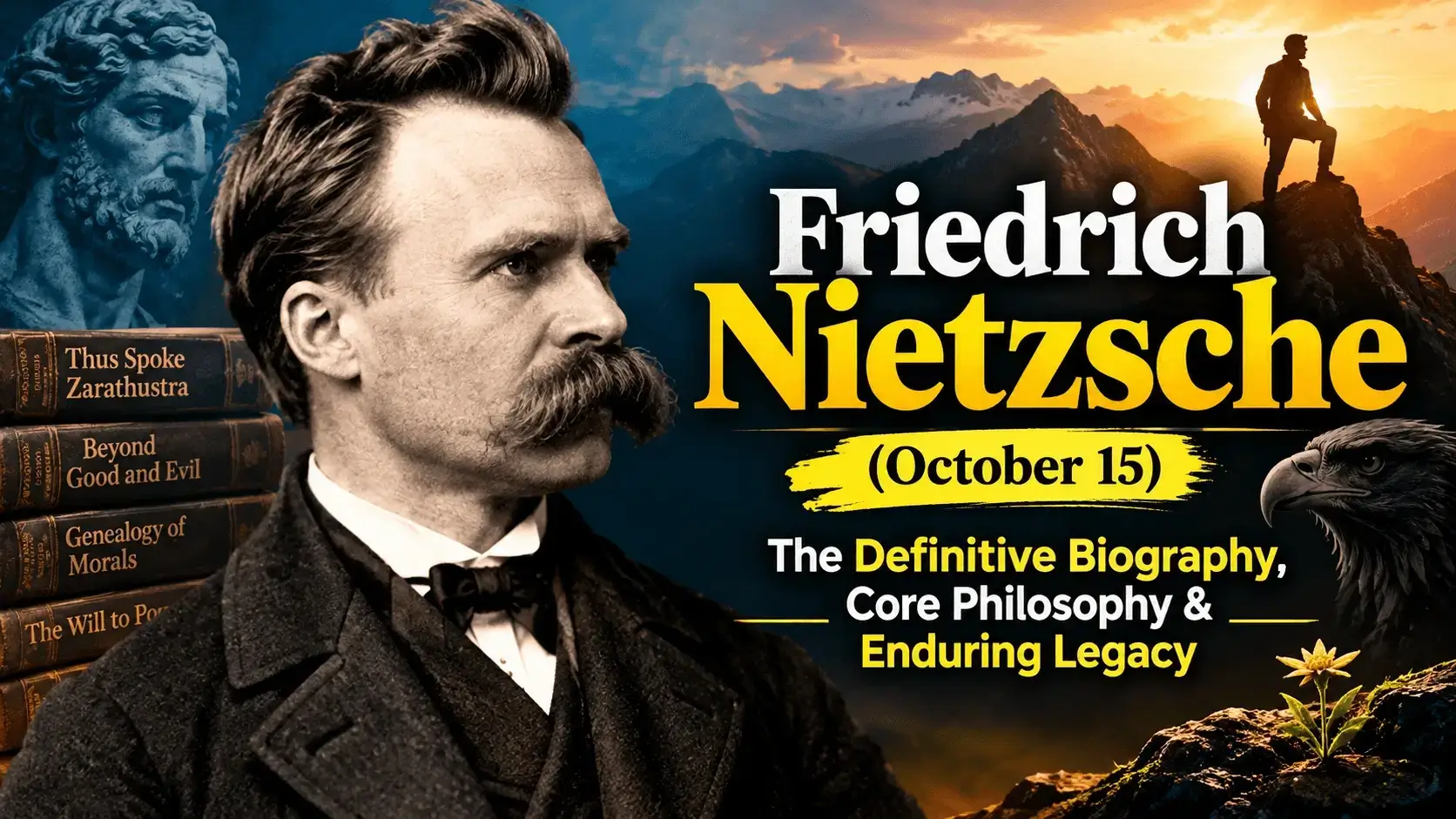
Archival portrait of German philosopher Friedrich Wilhelm Nietzsche (1844–1900).
Fast Facts: Friedrich Nietzsche (1844–1900)
- Born: October 15, 1844 (Röcken, Saxony, Kingdom of Prussia)
- Died: August 25, 1900 (Weimar, German Empire)
- Academic Prodigy: Appointed Chair of Classical Philology at University of Basel at age 24.
- Key Philosophies: The Will to Power, the Übermensch (Overman), Master-Slave Morality, Eternal Recurrence, Apollonian vs. Dionysian, Amor Fati.
- Magnum Opus: Thus Spoke Zarathustra (Also sprach Zarathustra, 1883–1885).
- Famous Declaration: "God is dead. God remains dead. And we have killed him." (The Gay Science, 1882).
1. The Making of a Prodigy: From Röcken to the Chair at Basel
Born the son of a Lutheran pastor in the small Prussian village of Röcken, young Friedrich showed breathtaking philological talent. Enrolling at the universities of Bonn and Leipzig, his scholarly papers on ancient Greek texts were so astonishingly mature that the University of Basel conferred upon him a full professorship in classical philology in 1869—without him even having written a formal doctoral dissertation.
In his inaugural book, The Birth of Tragedy (1872), Nietzsche revolutionized aesthetic theory by demonstrating that Greek civilization drew its vitality not merely from serene, rational order (the Apollonian), but from wild, ecstatic, suffering-infused communal music and passion (the Dionysian).
2. Core Philosophical Concepts Explained
Nietzsche's thought is often mischaracterized as nihilistic; in reality, his life's quest was to conquer nihilism and discover profound grounds for saying "Yes!" to life (Amor Fati).
- The Death of God & The Crisis of Meaning: By declaring the "death of God" in The Gay Science, Nietzsche was not celebrating atheism, but diagnosing a cultural crisis: the scientific Enlightenment had shattered the theological foundations of Western ethics, leaving humanity vulnerable to creeping nihilism unless individuals created their own elevated values.
- The Will to Power (Der Wille zur Macht): Unlike Schopenhauer's passive "will to survive," Nietzsche asserted that the driving force of all organic life is the desire for growth, self-mastery, transformation, and artistic creation.
- The Übermensch (The Overman / Higher Self): Introduced in Thus Spoke Zarathustra, the Übermensch is not a military conqueror, but the autonomous, self-disciplined individual who triumphs over societal mediocrity, creates personal meaning, and affirms life despite its inherent suffering.
- Master vs. Slave Morality: In On the Genealogy of Morality, Nietzsche traced how Judeo-Christian values inverted ancient noble virtues (strength, beauty, aristocratic honor) into "slave morality," which elevated meekness and pity out of resentment (ressentiment).
3. Chronological Timeline of Major Works
| Year | Masterpiece Title | Key Theme & Significance |
|---|---|---|
| 1872 | The Birth of Tragedy | Introduced the dichotomy of Apollonian order vs. Dionysian creative frenzy. |
| 1878 | Human, All Too Human | Broke with romanticism and Wagner; adopted crisp aphorisms on human psychology. |
| 1882 | The Gay Science | First formulation of the "Death of God" and the doctrine of Eternal Recurrence. |
| 1883–1885 | Thus Spoke Zarathustra | Poetic philosophical epic articulating the Übermensch and self-transcendence. |
| 1886 | Beyond Good and Evil | Ruthless critique of traditional metaphysics and the foundation of perspectivism. |
| 1887 | On the Genealogy of Morality | Historical inquiry into the origin of guilt, bad conscience, and ascetic ideals. |