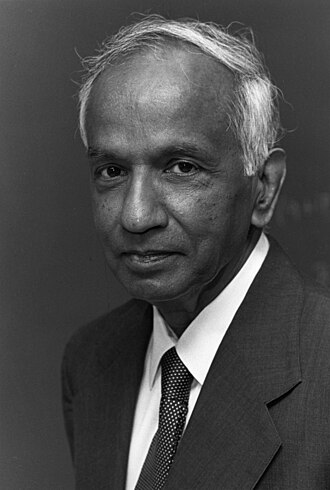
Subrahmanyan Chandrasekhar
One of the towering mathematical astrophysicists of the 20th century who won the 1983 Nobel Prize in Physics for formulating the mathematical theory of stellar evolution, discovering the maximum mass threshold of a stable white dwarf star (the Chandrasekhar Limit, ~1.44 solar masses).
Subrahmanyan Chandrasekhar Biography (October 19): The Nobel Astrophysicist Who Mapped the Fate of Dying Stars
A deeply researched biography of Nobel laureate Subrahmanyan Chandrasekhar on his October 19 birthday, exploring his voyage to Cambridge, the Chandrasekhar Limit, black hole mechanics, and NASA Chandra Observatory.
Read Full Editorial Biography & Historical Legacy →50+ Best Subrahmanyan Chandrasekhar Quotes, Astrophysics Wisdom & Birthday Tributes (2026)
Explore 50+ inspiring quotes on scientific truth, cosmic elegance, mathematical rigour, and stellar astrophysics by Nobel Laureate Subrahmanyan Chandrasekhar celebrating October 19.
Explore 50+ Quotes, Wishes & Tributes →Life & Legacy Overview
In 1930, during his steamship journey from India to Cambridge University on a government scholarship, the nineteen-year-old calculated the maximum mass of an electron-degenerate star—the celebrated 'Chandrasekhar Limit'. He mathematically proved that dying stars exceeding 1.44 times the mass of the Sun cannot stabilize as white dwarfs and must collapse under their own gravity, establishing the theoretical bedrock for neutron stars and black holes. Despite vehement early opposition from Sir Arthur Eddington, Chandrasekhar's mathematical rigor stood unshakable.
Moving to the United States in 1937, Chandrasekhar served for over five decades as a legendary professor at the University of Chicago and Yerkes Observatory, editing the Astrophysical Journal for nearly twenty years. In 1983, he was awarded the Nobel Prize in Physics. Following his death in 1995, NASA named its premier flagship space observatory, the Chandra X-ray Observatory, in his eternal honor.
- Mathematical Formulation of the Chandrasekhar Limit (1.44 Solar Masses, 1930)
- Nobel Prize in Physics (1983 for Theoretical Studies of Stellar Structure and Evolution)
- NASA Chandra X-ray Observatory (Named in His Honor in 1999)
- The Mathematical Theory of Black Holes (Monumental Monograph, 1983)
- Managing Editor of the Astrophysical Journal (1952–1971)
- National Medal of Science (1966) & Copley Medal (1984)
Notable Quotes by Subrahmanyan Chandrasekhar View All 50+ →
Featured Content for Subrahmanyan Chandrasekhar
Key Historical Details
Death Anniversary Hub
Explore all famous personalities, biographies, quotes, and wishes under Death Anniversary.
Explore Death Anniversary Hub →