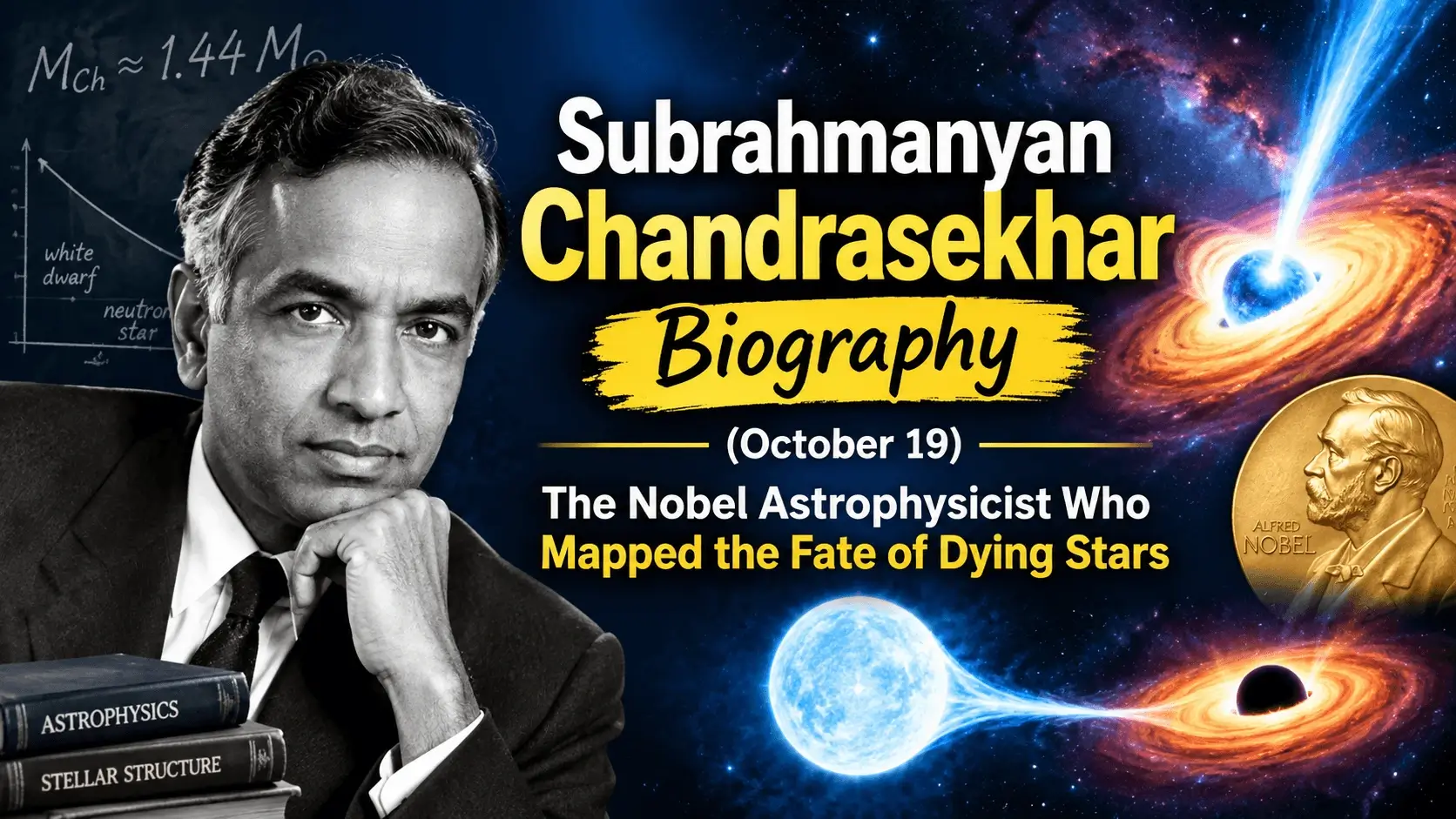
Every year on October 19, the global community commemorates Subrahmanyan Chandrasekhar (1910–1995), Nobel Laureate in Physics (1983), Mathematical Astrophysicist & Discoverer of the Chandrasekhar Limit. Renowned across India and globally for revolutionary contributions to Science, their life work remains an enduring testament to human courage, creative vision, and excellence.
1. Early Foundations, Background & Formative Years
Subrahmanyan Chandrasekhar was born on October 19, 1910, in Lahore into an illustrious Tamil family of scholars; his paternal uncle was Sir C. V. Raman, the 1930 Nobel Laureate in Physics. Educated at Presidency College in Madras, Chandrasekhar demonstrated astonishing mathematical virtuosity, publishing his first research paper on thermodynamics before turning nineteen.
Growing up in India, Subrahmanyan Chandrasekhar displayed exceptional focus and dedication from an early age. Formative experiences nurtured an unwavering commitment to truth, discipline, and pushing beyond conventional boundaries.
2. Groundbreaking Breakthroughs & Monumental Achievements
In 1930, during his steamship journey from India to Cambridge University on a government scholarship, the nineteen-year-old calculated the maximum mass of an electron-degenerate star—the celebrated 'Chandrasekhar Limit'. He mathematically proved that dying stars exceeding 1.44 times the mass of the Sun cannot stabilize as white dwarfs and must collapse under their own gravity, establishing the theoretical bedrock for neutron stars and black holes. Despite vehement early opposition from Sir Arthur Eddington, Chandrasekhar's mathematical rigor stood unshakable.
The impact of Subrahmanyan Chandrasekhar's seminal work transformed our understanding of Science. Through unyielding perseverance against institutional skepticism and complex obstacles, they produced historic milestones that redefined the standards of the discipline.
3. Cultural Resonance, Philosophy & World Impact
Moving to the United States in 1937, Chandrasekhar served for over five decades as a legendary professor at the University of Chicago and Yerkes Observatory, editing the Astrophysical Journal for nearly twenty years. In 1983, he was awarded the Nobel Prize in Physics. Following his death in 1995, NASA named its premier flagship space observatory, the Chandra X-ray Observatory, in his eternal honor.
One of the towering mathematical astrophysicists of the 20th century who won the 1983 Nobel Prize in Physics for formulating the mathematical theory of stellar evolution, discovering the maximum mass threshold of a stable white dwarf star (the Chandrasekhar Limit, ~1.44 solar masses).
4. Key Milestones & Notable Works
- Mathematical Formulation of the Chandrasekhar Limit (1.44 Solar Masses, 1930)
- Nobel Prize in Physics (1983 for Theoretical Studies of Stellar Structure and Evolution)
- NASA Chandra X-ray Observatory (Named in His Honor in 1999)
- The Mathematical Theory of Black Holes (Monumental Monograph, 1983)
- Managing Editor of the Astrophysical Journal (1952–1971)
- National Medal of Science (1966) & Copley Medal (1984)
5. Enduring Legacy for Future Generations
Generations of practitioners, scholars, and admirers worldwide continue to draw inspiration from the life of Subrahmanyan Chandrasekhar. On October 19, we reflect upon a legacy that transcends national frontiers, reminding humanity that visionary purpose and integrity endure across the centuries.
6. Frequently Asked Questions (FAQ) About Subrahmanyan Chandrasekhar
When and where was Subrahmanyan Chandrasekhar born?
Subrahmanyan Chandrasekhar was born on 1910-10-19 in Lahore, Punjab, British India (now Pakistan).
What is Subrahmanyan Chandrasekhar most famous for?
Subrahmanyan Chandrasekhar is globally celebrated for: Nobel Laureate in Physics (1983), Mathematical Astrophysicist & Discoverer of the Chandrasekhar Limit.
What are the primary honors and achievements of Subrahmanyan Chandrasekhar?
Key achievements include Mathematical Formulation of the Chandrasekhar Limit (1.44 Solar Masses, 1930) and Nobel Prize in Physics (1983 for Theoretical Studies of Stellar Structure and Evolution).
Why is October 19 significant for Subrahmanyan Chandrasekhar?
October 19 marks the historic birth anniversary of Subrahmanyan Chandrasekhar, observed worldwide by historians, admirers, and students of Science.


