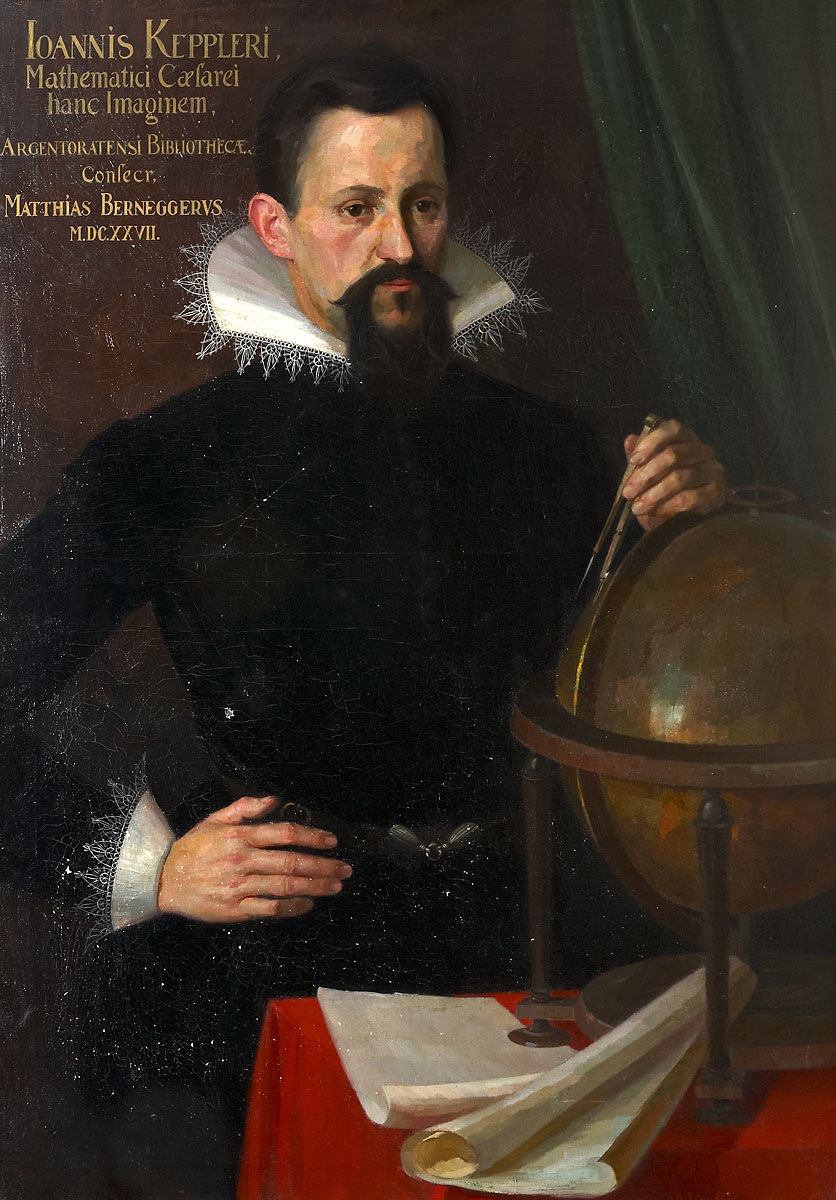
Johannes Kepler (1571 – 1630) was a towering figure in Germany and world history, widely celebrated as German Astronomer, Mathematician & Key Figure of Scientific Revolution. Their transformative contributions left an enduring imprint on human civilization.
At a Glance: Johannes Kepler
Major Historical Impact & Defining Contributions
Born on December 27, 1571, in Weil der Stadt, Johannes Kepler was introduced to astronomy in childhood, observing the Great Comet of 1577 and a lunar eclipse. Educated in theology, philosophy, and mathematics at the University of Tübingen, Kepler became an ardent advocate of the Copernican heliocentric system under Michael Maestlin. In 1600, he joined Danish astronomer Tycho Brahe in Prague as an assistant. Following Tycho's sudden death in 1601, Kepler was appointed Imperial Mathematician to Holy Roman Emperor Rudolf II. Analyzing Tycho's meticulous observational data of Mars, Kepler made the historic breakthrough that planetary orbits are not perfect circles, but ellipses with the Sun at one focus (First Law), and that a line joining a planet and the Sun sweeps out equal areas during equal intervals of time (Second Law), published in his 1609 masterpiece 'Astronomia Nova'. In 1619, in 'Harmonices Mundi' (The Harmony of the World), Kepler unveiled his Third Law, relating the orbital period of planets to their distances from the Sun. Beyond celestial mechanics, Kepler founded modern optics by explaining image formation in the eye and inventing the Keplerian refracting telescope. Passing away on November 15, 1630, in Regensburg amidst the Thirty Years' War, Kepler remains an enduring titan whose mathematical laws unified physics and the cosmos.
Key Milestones, Works & Enduring Achievements
Throughout an extraordinary journey, Johannes Kepler established landmark milestones that continue to inspire scholars, creators, and leaders:
- Astronomia Nova (1609 - First & Second Laws of Planetary Motion)
- Harmonices Mundi (The Harmony of the World, 1619 - Third Law)
- Epitome Astronomiae Copernicanae (1618–1621 - Complete heliocentric astronomy)
- Rudolphine Tables (Tabulae Rudolphinae, 1627 - Most accurate planetary tables of the era)
- Dioptrice (1611 - Foundation of modern optics and Keplerian telescope)
Enduring Philosophy & Timeless Words
Reflecting on human nature, duty, and excellence, Johannes Kepler also observed:
Read All Curated Quotes & Tributes
Explore our comprehensive collection of inspiring quotes, personal reflections, and historical tributes honoring Johannes Kepler on November 15.