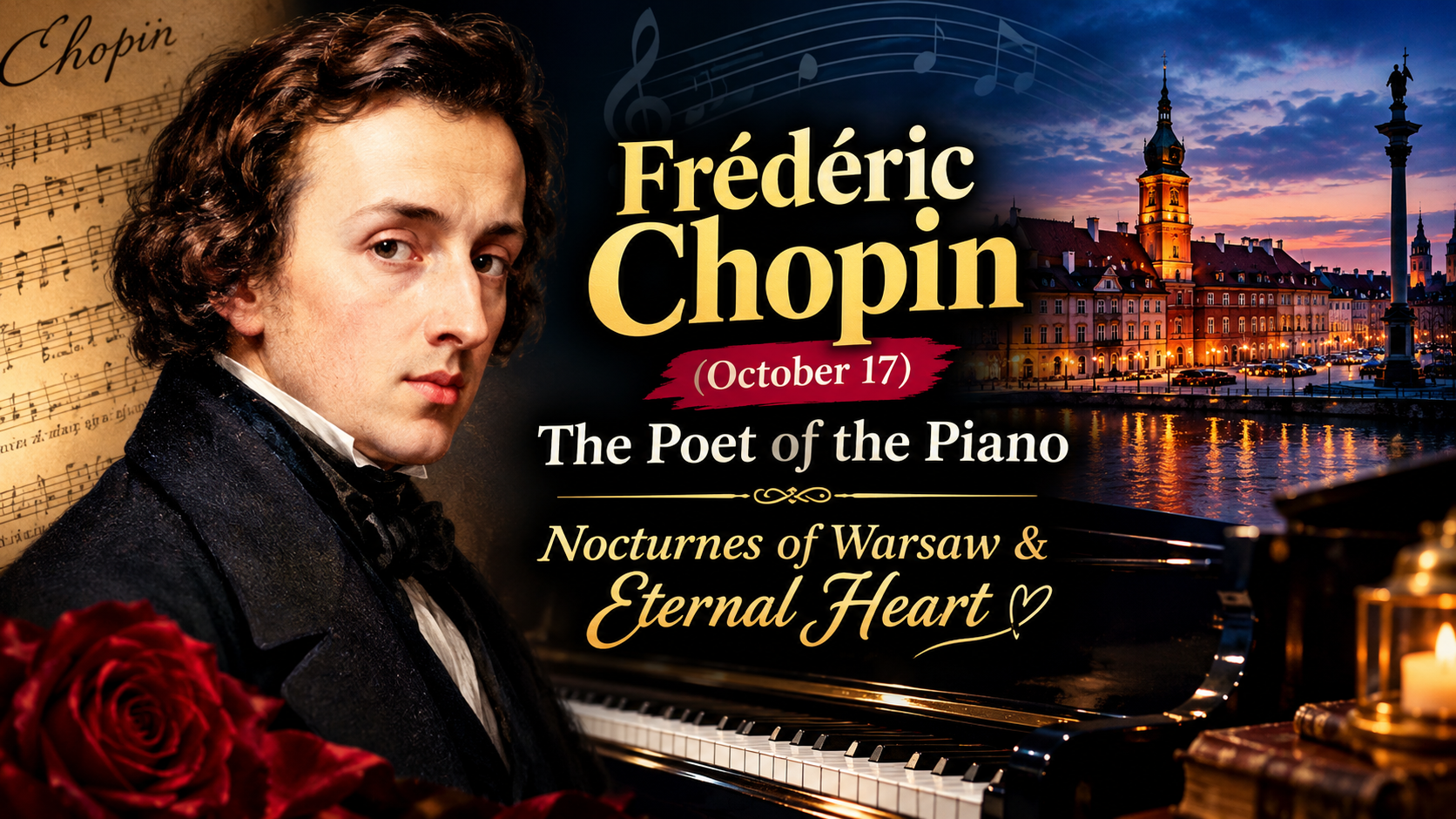
On October 17, 1849, in an apartment overlooking the elegant Place Vendôme in Paris, breathed his last one of the most sublime creative geniuses in the history of human civilization: Frédéric Chopin (born March 1, 1810). Dead of tuberculosis at only thirty-nine years of age, Chopin lived as the quintessential musical poet of Romanticism—an artist who took the domestic keyboard instrument and transformed it into a vehicle of unprecedented emotional nuance, technical revolution, and heartbreaking national longing.
1. A Polish Prodigy: Żelazowa Wola and the Mazovian Plains
Born in Żelazowa Wola near Warsaw to a French father, Nicolas Chopin, and a noble Polish mother, Justyna Krzyżanowska, young Fryderyk displayed musical capabilities that drew immediate comparisons to Mozart. By age seven, he had composed two polonaises; by age eight, he made his public debut at the Radziwiłł Palace in Warsaw. Educated at the Warsaw Lyceum and the Warsaw Conservatory under Józef Elsner, Chopin received rigorous contrapuntal training grounded in J.S. Bach, an influence that remained the structural backbone of his music throughout his life.
Crucially, during childhood summers in the rural Mazovian countryside, Chopin listened intently to the folk songs, village weddings, and rustic rhythms of Polish peasants. He absorbed the syncopated accents of the mazur, kujawiak, and oberek, as well as the proud aristocratic cadence of the polonaise. These native dances were not decorative folklore for Chopin; they were the holy essence of Polish identity, which he would later elevate into the highest forms of classical European art.
2. Exile in Paris: The Velvet Touch and the Salon
In November 1830, Chopin departed Warsaw to conquer the musical capitals of Europe. Just weeks later, the Polish November Uprising broke out against Russian imperial domination. When Russian troops brutally recaptured Warsaw in September 1831, Chopin was stranded in Stuttgart, pouring his fury and despair into the tempestuous Revolutionary Étude (Op. 10 No. 12). He arrived in Paris as an exile, never to see his beloved Poland again.
In Paris, then the cultural capital of the Western world, Chopin encountered fellow titans: Franz Liszt, Felix Mendelssohn, Hector Berlioz, and painter Eugène Delacroix. While Liszt dazzled cavernous concert halls with thunderous showmanship, Chopin despised commercial spectacle, performing publicly only about thirty times in his entire adult life. Instead, Chopin conquered the aristocratic salons of Paris. Playing on his preferred Pleyel pianos, his touch was praised for its crystalline delicacy, shimmering pedal effects, and revolutionary tempo rubato (stolen time)—where the left hand maintains strict tempo while the right hand sings freely with poetic flexibility.
3. The Golden Decade: George Sand and the Masterpieces
Between 1838 and 1847, Chopin lived in an intense, complex domestic and creative relationship with the celebrated French feminist novelist George Sand (Aurore Dupin). Spending summers at Sand's estate in Nohant in central France, away from the distractions and damp air of Paris, Chopin enjoyed his most prolific creative period.
Here he composed works that permanently expanded the vocabulary of piano literature:
- The 24 Preludes, Op. 28: Inspired by Bach's Well-Tempered Clavier, traversing all twenty-four major and minor keys, including the haunting Raindrop Prelude composed during a miserable, rain-soaked winter in Mallorca.
- The Four Ballades: Pioneering a brand-new musical genre, fusing epic narrative scope with breathtaking virtuosity, especially the sublime Ballade No. 1 in G minor and Ballade No. 4 in F minor.
- The Heroic Polonaise in A-flat major, Op. 53: An unyielding monument of patriotic defiance celebrating Polish chivalry and martial glory.
- The Nocturnes: Perfecting the genre invented by John Field, infusing it with Italian bel canto operatic melody (inspired by Vincenzo Bellini) and profound harmonic poignancy.
4. The Untranslatable Sorrow: The Philosophy of "Żal"
Chopin famously remarked that his entire musical universe could be summarized by a single, untranslatable Polish word: "Żal" (pronounced zhal). In Polish, żal encompasses a complex tapestry of sorrow, grief, nostalgic yearning, bitter regret, and proud, quiet defiance. In Chopin's hands, żal was not self-pitying depression; it was the sacred sorrow of an artist who carries the memory of an enslaved homeland, the fragility of mortal life, and the longing for an unattainable perfection.
Even in his most joyous waltzes, a subtle silver thread of melancholy weaves beneath the champagne sparkle. As German poet Heinrich Heine remarked: "Chopin is neither a Frenchman, an Englishman, nor a German; he comes from the land of Mozart, Raphael, and Goethe. But his true homeland is the dream realm of poetry."
5. The Final Agony: October 17, 1849 & The Enshrined Heart
Following the painful rupture of his relationship with George Sand in 1847 and an exhausting, damp concert tour of England and Scotland in 1848, Chopin's chronic tuberculosis entered its terminal phase. By the autumn of 1849, bedridden in his apartment at 12 Place Vendôme, surrounded by his devoted sister Ludwika and close friends, Chopin prepared serenely for death, asking that Mozart's Requiem be performed at his funeral.
At 2:00 AM on October 17, 1849, Frédéric Chopin passed away at age thirty-nine. Over four thousand mourners accompanied his cortege to the Church of the Madeleine. In accordance with his explicit dying instructions, doctors performed an autopsy to remove his heart. While his body was interred at Père Lachaise Cemetery beneath a statue of Euterpe (the muse of music), his sister Ludwika smuggled his heart preserved in cognac across Russian checkpoints back to Warsaw. Today, it remains reverently sealed in a stone pillar of the Church of the Holy Cross in Warsaw, bearing the biblical inscription: "For where your treasure is, there will your heart be also."
6. The Immortal Legacy of the Poet of the Piano
Frédéric Chopin remains a singular phenomenon in classical music: almost his entire oeuvre was written exclusively for a single instrument, yet he stands alongside Bach, Mozart, and Beethoven among the towering summits of Western culture. By inventing modern piano technique, pioneering nationalist musical expression, and discovering harmonies that foreshadowed Debussy and the Impressionists, Chopin gave humanity an eternal refuge of beauty. On October 17, music lovers worldwide listen to his nocturnes and polonaises with hushed gratitude for the frail giant whose heart beat forever for Poland and art.


