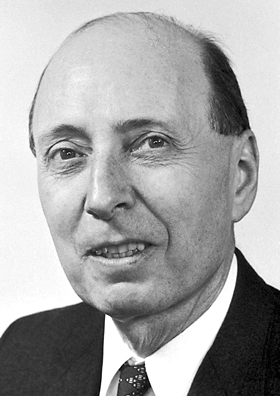
Eugene Wigner (1902 – 1995) was a towering figure in Hungary and world history, widely celebrated as Nobel Laureate Theoretical Physicist and Mathematician. Their transformative contributions left an enduring imprint on human civilization.
At a Glance: Eugene Wigner
Major Historical Impact & Defining Contributions
Born on November 17, 1902, in Budapest into a cultured Jewish family, Eugene Paul Wigner attended the famous Fasori Lutheran Gymnasium alongside his lifelong friend John von Neumann. Moving to Berlin, he earned his doctorate in chemical engineering at the Technical University of Berlin while attending theoretical physics colloquia alongside Albert Einstein, Max Planck, and Werner Heisenberg. In the late 1920s, Wigner made a monumental contribution to physics by introducing the mathematical framework of group theory to quantum mechanics. His 1931 monograph 'Group Theory and Its Application to the Quantum Mechanics of Atomic Spectra' proved that fundamental symmetries in physical laws dictate the conservation laws of nature (such as parity and angular momentum). Emigrating to the United States in 1930 to join the faculty of Princeton University, Wigner became a central figure in nuclear physics, formulating the Breit-Wigner formula for nuclear resonance. In August 1939, alarmed by the Nazi threat, Wigner accompanied Leo Szilard to visit Albert Einstein, drafting the historic Einstein-Szilard letter to President Franklin D. Roosevelt that initiated the American atomic project. During the Manhattan Project at the University of Chicago Metallurgical Laboratory, Wigner headed the team that designed the water-cooled Hanford nuclear reactors (the B-Reactor), which produced the plutonium needed for the war effort, displaying unparalleled precision in nuclear engineering. In 1963, Wigner was awarded the Nobel Prize in Physics 'for his contributions to the theory of the atomic nucleus and the elementary particles, particularly through the discovery and application of fundamental symmetry principles.' In epistemology and philosophy of science, his seminal 1960 essay 'The Unreasonable Effectiveness of Mathematics in the Natural Sciences' remains an intellectual classic. Wigner died in Princeton, New Jersey, on January 1, 1995, at age ninety-two.
Key Milestones, Works & Enduring Achievements
Throughout an extraordinary journey, Eugene Wigner established landmark milestones that continue to inspire scholars, creators, and leaders:
- Group Theory and Its Application to Quantum Mechanics (1931 - Foundational treatise)
- Nobel Prize in Physics (1963 - Symmetries in quantum and nuclear physics)
- The Unreasonable Effectiveness of Mathematics in the Natural Sciences (1960)
- Design of the Hanford B-Reactor (First full-scale production nuclear reactor, 1944)
- Formulation of the Breit-Wigner Formula and Wigner's Friend Thought Experiment
Enduring Philosophy & Timeless Words
Reflecting on human nature, duty, and excellence, Eugene Wigner also observed:
Read All Curated Quotes & Tributes
Explore our comprehensive collection of inspiring quotes, personal reflections, and historical tributes honoring Eugene Wigner on November 17.