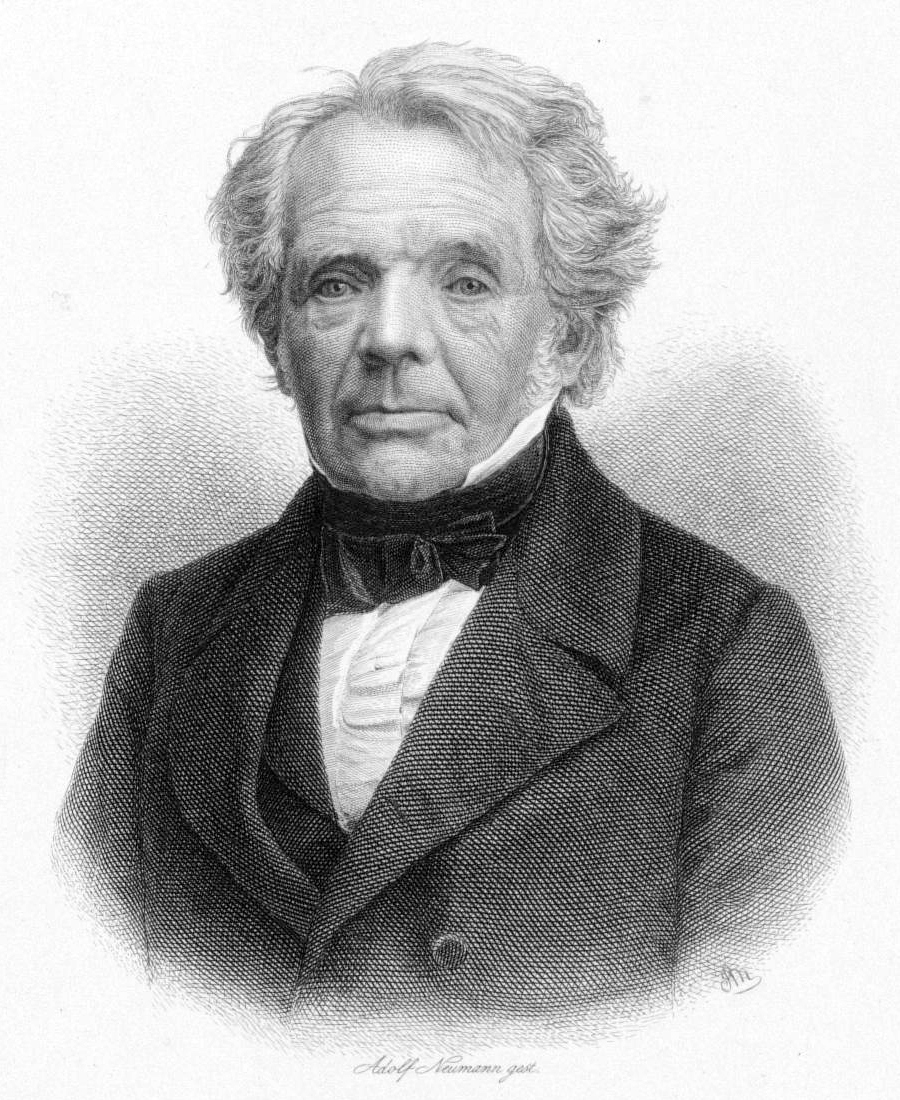
August Möbius (1790 – 1868) was a towering figure in Germany and world history, widely celebrated as German Mathematician, Theoretical Astronomer, and Topology Pioneer. Their transformative contributions left an enduring imprint on human civilization.
At a Glance: August Möbius
Major Historical Impact & Defining Contributions
Born on November 17, 1790, in Schulpforta, Saxony, a descendant of religious reformer Martin Luther, August Ferdinand Möbius studied mathematics, astronomy, and physics at the University of Leipzig. In 1813, he studied theoretical astronomy under Carl Friedrich Gauss at the University of Göttingen, followed by mathematics under Johann Pfaff in Halle. In 1816, Möbius was appointed extraordinary professor of astronomy and higher mechanics at the University of Leipzig, and in 1848 became director of the Leipzig Astronomical Observatory, supervising its modernization. In 1827, Möbius published his groundbreaking mathematical masterpiece 'Der barycentrische Calcul' (The Barycentric Calculus). In this work, he introduced barycentric coordinates—a revolutionary system defining geometric points through centers of gravity—which laid the foundations for projective geometry and computer graphics. In number theory, he formulated the Möbius function μ(n) and the famous Möbius inversion formula (1832), which established deep connections between arithmetic functions and multiplicative identities. In 1858, while investigating polyhedra for a prize competition of the French Academy of Sciences, Möbius made his most famous discovery: he discovered that a strip of paper given a half-twist and joined at the ends creates a continuous two-dimensional surface with only one side and only one boundary edge—the 'Möbius strip' (independently discovered around the same time by Johann Benedict Listing). This radical object dismantled classical assumptions about geometry and sparked the birth of algebraic topology and the study of non-orientable surfaces. In projective geometry, he introduced Möbius transformations (linear fractional transformations of the Riemann sphere). Möbius died in Leipzig on September 26, 1868, at age seventy-seven, remembered as one of the most imaginative geometric minds in human history.
Key Milestones, Works & Enduring Achievements
Throughout an extraordinary journey, August Möbius established landmark milestones that continue to inspire scholars, creators, and leaders:
- Discovery of the Möbius Strip (1858 - Foundation of modern topology and non-orientable surfaces)
- Der barycentrische Calcul (1827 - Introduction of barycentric coordinates in projective geometry)
- The Möbius Inversion Formula and Möbius Function in Number Theory (1832)
- Formulation of Möbius Transformations (Conformal mappings in complex analysis)
- Director and Modernization of the Leipzig University Astronomical Observatory (1848–1868)
Enduring Philosophy & Timeless Words
Reflecting on human nature, duty, and excellence, August Möbius also observed:
Read All Curated Quotes & Tributes
Explore our comprehensive collection of inspiring quotes, personal reflections, and historical tributes honoring August Möbius on November 17.