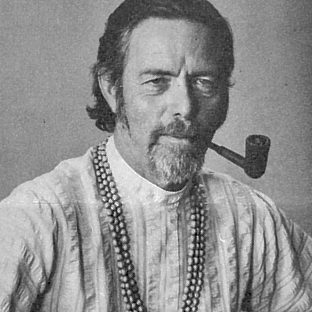
Alan Watts (1915 – 1973) was a towering figure in United Kingdom and world history, widely celebrated as Philosopher, Comparative Theologian, Writer, and Interpreter of Eastern Wisdom. Their transformative contributions left an enduring imprint on human civilization.
At a Glance: Alan Watts
Major Historical Impact & Defining Contributions
Born on January 6, 1915, in Chislehurst, Kent, England, Alan Watts became fascinated with Asian art, philosophy, and Eastern spirituality as an adolescent. In 1936, attending the World Congress of Faiths in London, he met the eminent Zen scholar D.T. Suzuki, which profoundly shaped his intellectual path. Watts moved to the United States in 1938 and earned a master's degree in theology from Seabury-Western Theological Seminary, serving briefly as an Episcopal priest before resigning in 1950 to pursue independent philosophical inquiry. Joining the faculty of the American Academy of Asian Studies in San Francisco in 1951, Watts began hosting regular broadcasts on public radio station KPFA in Berkeley. His warm, resonant voice, self-described identity as a 'philosophical entertainer', and luminous ability to explain paradoxical Zen koans and Taoist concepts of wu wei (effortless action) captivated the burgeoning counterculture and academic communities. In 1957, Watts published 'The Way of Zen', which became one of the best-selling and most accessible introductions to Buddhism in history. Followed by 'The Wisdom of Insecurity' (1951) and 'The Book: On the Taboo Against Knowing Who You Are' (1966), Watts argued that the conventional Western sense of self—an isolated ego trapped in a bag of skin—was a hallucinatory illusion, and that human consciousness is fundamentally an expression of the entire cosmos. Watts passed away peacefully in his sleep at his cabin on Mount Tamalpais on November 16, 1973, at age fifty-eight, leaving a recorded legacy of hundreds of lectures that remain globally celebrated.
Key Milestones, Works & Enduring Achievements
Throughout an extraordinary journey, Alan Watts established landmark milestones that continue to inspire scholars, creators, and leaders:
- The Way of Zen (1957 - Definitive introduction to Zen philosophy for the West)
- The Wisdom of Insecurity: A Message for an Age of Anxiety (1951)
- The Book: On the Taboo Against Knowing Who You Are (1966 - Metaphysical masterpiece)
- Nature, Man and Woman (1958 - Exploring human ecology and Chinese Taoism)
- Psychotherapy East and West (1961 - Bridging psychiatric insight and Eastern liberation)
Enduring Philosophy & Timeless Words
Reflecting on human nature, duty, and excellence, Alan Watts also observed:
Read All Curated Quotes & Tributes
Explore our comprehensive collection of inspiring quotes, personal reflections, and historical tributes honoring Alan Watts on November 16.