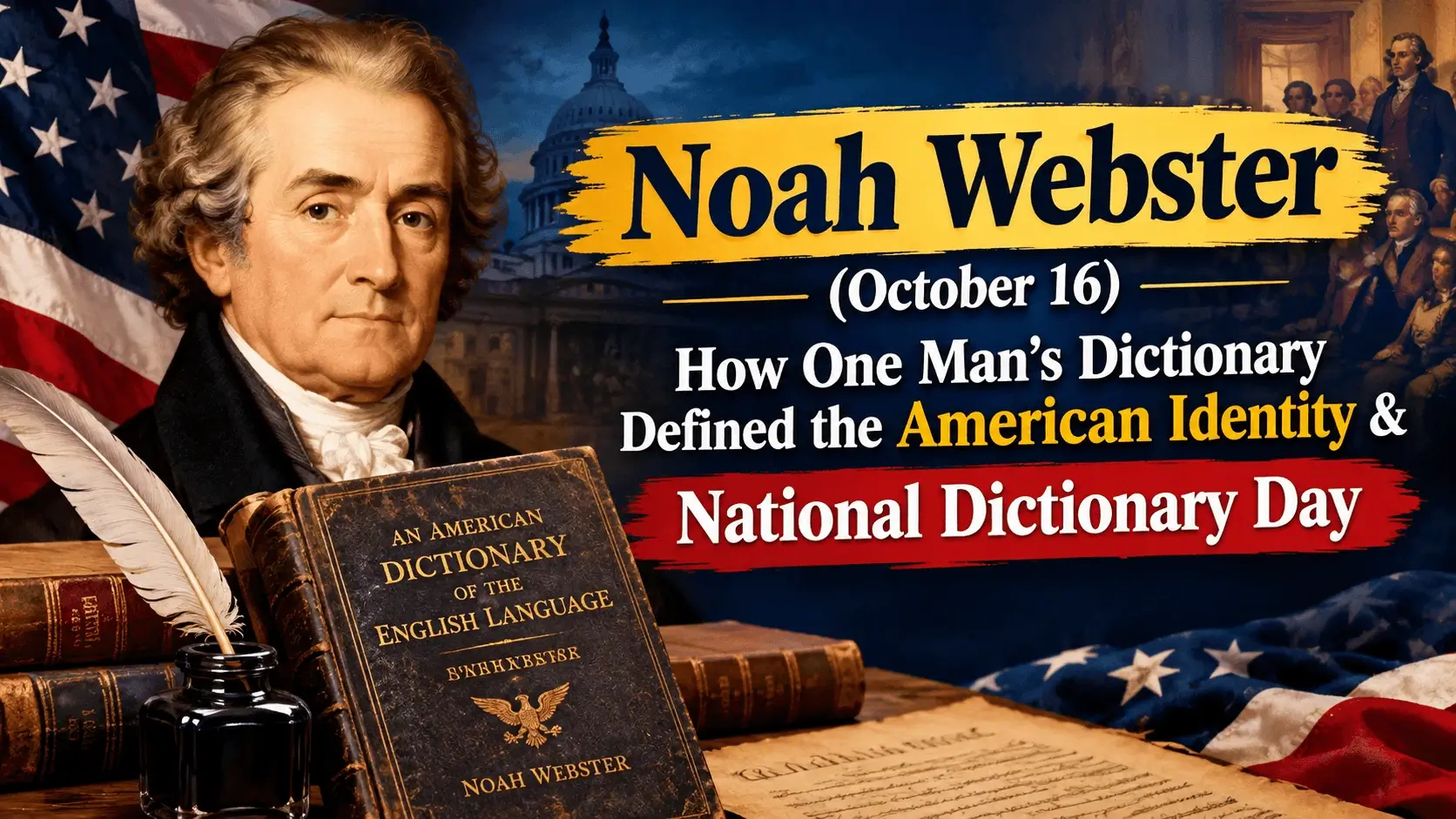
Celebrated annually on October 16 across schools, universities, public libraries, and literary societies throughout the United States, National Dictionary Day commemorates the birthday of Noah Webster (1758–1843). Recognized as the "Father of American Scholarship and Education," Webster’s lifelong dedication to lexicography established an independent linguistic identity for the American Republic and created the modern English dictionary.
Lexicography: The Living Mirror of Human Language
A dictionary is not a static, dogmatic rulebook; it is a dynamic empirical record of human expression. Modern lexicographers at major institutions—including Merriam-Webster, Oxford University Press, and Cambridge—monitor trillions of words of contemporary text:
- Descriptive vs. Prescriptive Lexicography: Rather than arbitrarily commanding how people "ought" to speak, professional dictionaries document how language is actually utilized across science, literature, digital discourse, and cultural communities.
- The Evolution of Vocabulary: Language continually absorbs new conceptual realities—from scientific breakthroughs and technological terms to societal idioms—reflecting the intellectual vitality of an evolving civilization.
Vocabulary as the Foundation of Critical Literacy
Extensive cognitive research confirms that vocabulary acquisition is directly correlated with reading comprehension, critical reasoning, and academic achievement:
- Precision in Thought and Debate: A rich, nuanced vocabulary enables citizens to express complex thoughts with nuance, identify rhetorical fallacies, and engage constructively in democratic debate.
- Etymological Literacy: Understanding Greek, Latin, Germanic, Arabic, and Sanskrit root words unlocks the structural morphology of hundreds of thousands of English words, demystifying advanced scientific and legal terminology for students.
Educational Traditions: The Dictionary Project
On National Dictionary Day, educational foundations such as The Dictionary Project distribute millions of free personal print dictionaries to third-grade elementary students nationwide, marking the critical educational transition where children shift from "learning to read" to "reading to learn."
Noah Webster: The Father of American Education
Noah Webster Jr. was born on October 16, 1758, in West Hartford, Connecticut. Following the American Revolutionary War, Webster argued passionately that a politically independent republic could not remain intellectually subservient to British textbooks and British linguistic conventions.
In 1783, he published The First Part of a Grammatical Institute of the English Language, famously known as the "Blue-Backed Speller." For over a century, this modest textbook was used to teach reading, spelling, and moral civic values to over 100 million American schoolchildren, becoming the best-selling book in American history after the Bible.
The 1828 Magnum Opus: An American Dictionary
In 1807, at the age of 49, Webster embarked on a colossal twenty-year intellectual undertaking: creating a comprehensive, standardized dictionary of American English. To trace the etymological origins of words with scientific precision, Webster taught himself twenty-six languages, including Anglo-Saxon, Old Norse, Gothic, Hebrew, Arabic, Persian, and Sanskrit.
Published on April 14, 1828, Webster’s monumental two-volume An American Dictionary of the English Language contained 70,000 entries, defining 12,000 words that had never appeared in any prior English dictionary.
Webster standardized distinct American spelling conventions—removing superfluous silent letters (changing colour to color, honour to honor), transposing French suffixes (changing centre to center, theatre to theater), and simplifying phonetic spellings (changing musick to music, defence to defense).
The Genesis of National Dictionary Day
Following Webster's death in 1843, George and Charles Merriam acquired the publishing rights to Webster’s dictionary, creating the enduring Merriam-Webster brand. Over the 20th century, American educators and librarians officially designated Noah Webster’s birthday—October 16—as National Dictionary Day to inspire students to cultivate vocabulary, explore etymology, and appreciate the written word.