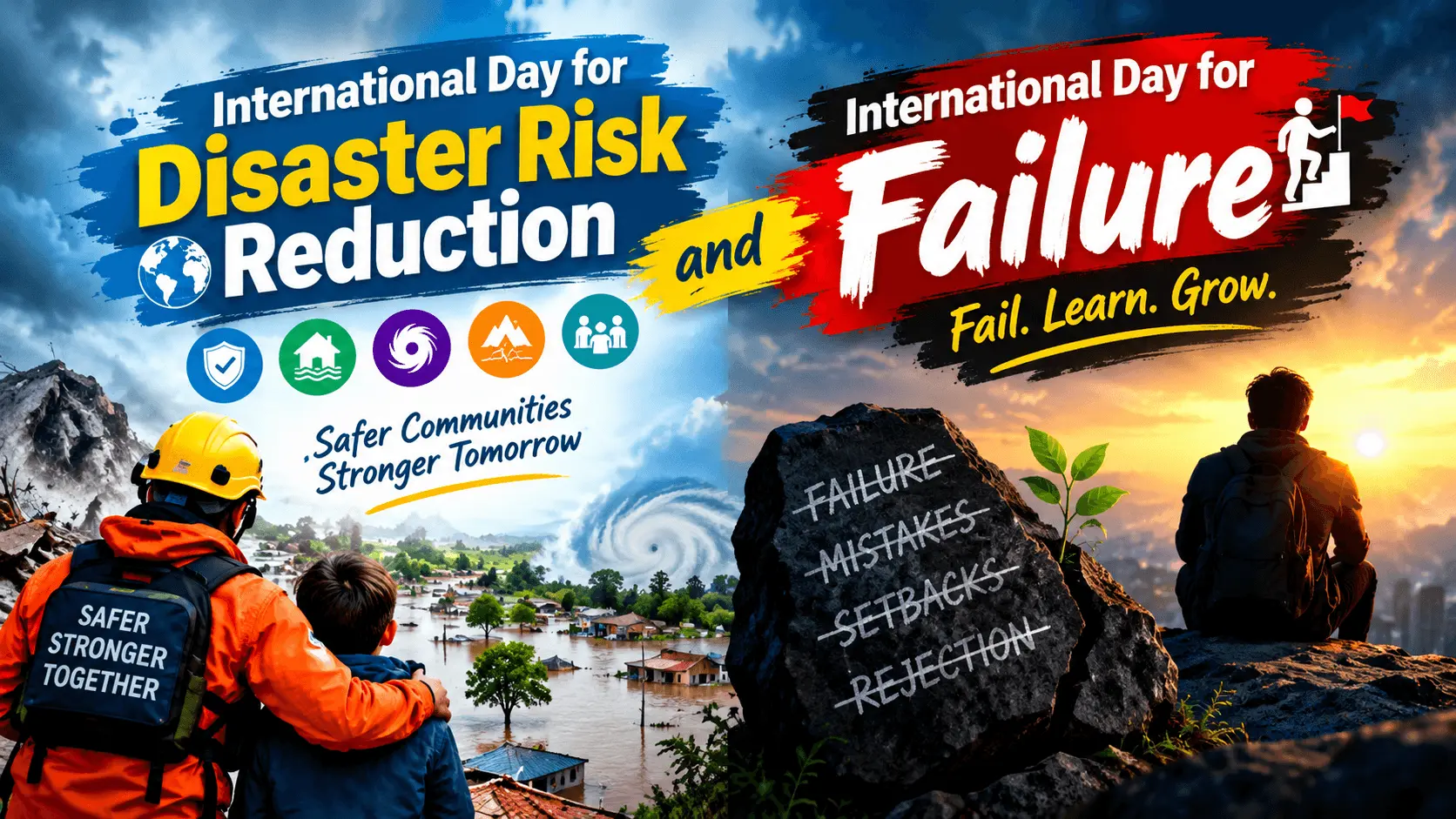
The International Day for Disaster Risk Reduction (IDDRR), commemorated worldwide every year on October 13, serves as the premier global platform for raising awareness on how communities can diminish vulnerability to natural and technological hazards.
Why Disasters Are Not "Natural"
A core tenet championed by the United Nations Office for Disaster Risk Reduction (UNDRR) is that while natural hazards—such as cyclones, earthquakes, tsunamis, droughts, and heatwaves—are inevitable geological and meteorological phenomena, disasters themselves are not natural. A hazard only escalates into a humanitarian catastrophe when human exposure, vulnerable infrastructure, poverty, and inadequate emergency planning intersect.
By investing in early warning telemetry, climate-resilient building codes, ecosystem conservation, and community-led preparedness drills, societies can absorb shocks, prevent loss of human lives, and safeguard decades of socioeconomic development.
The Sendai Framework for Disaster Risk Reduction (2015–2030)
Global resilience strategies operate under the Sendai Framework, adopted at the Third UN World Conference on Disaster Risk Reduction in Sendai, Japan. The framework shifts the global paradigm from managing disaster crises to managing comprehensive disaster risk across four core priorities:
- Priority 1: Understanding Disaster Risk — Leveraging real-time data, geospatial hazard mapping, and local indigenous knowledge.
- Priority 2: Strengthening Disaster Risk Governance — Enforcing transparent disaster management policies and cross-sector institutional coordination.
- Priority 3: Investing in Disaster Risk Reduction for Resilience — Channeling capital into flood barriers, earthquake-resistant engineering, and nature-based solutions.
- Priority 4: Enhancing Disaster Preparedness & Building Back Better — Ensuring rapid emergency response capacities and post-disaster reconstruction that guarantees future safety.
Target G: Early Warnings for All
The United Nations Secretary-General's landmark initiative, "Early Warnings for All," calls for universal coverage of multi-hazard early warning systems. Comprehensive evidence proves that giving vulnerable populations just 24 hours of advance warning before an extreme weather event can reduce subsequent damage by up to 30 percent and virtually eliminate preventable fatalities.
Genesis and UN General Assembly Resolutions
The origin of the International Day for Disaster Risk Reduction traces back to 1989, when the United Nations General Assembly adopted Resolution 44/236. This milestone declaration designated the 1990s as the International Decade for Natural Disaster Reduction (IDNDR) and instituted the second Wednesday of October as an international observance to elevate disaster awareness.
For nearly two decades, the observance mobilized scientific institutions, national hydrometeorological agencies, and humanitarian bodies. Recognizing the escalating threats posed by human-induced climate change and rapid urbanization, the UN General Assembly updated its mandate in December 2009 through Resolution 64/200, officially renaming the event to the International Day for Disaster Risk Reduction and establishing October 13 as its permanent calendar date.
Key Historical Milestones in Global Disaster Governance
- 1994 — The Yokohama Strategy and Plan of Action: The first major international framework emphasizing that disaster prevention, mitigation, and preparedness are far more cost-effective than post-disaster relief.
- 2005 — Hyogo Framework for Action 2005–2015 (HFA): Adopted in Kobe, Hyogo, Japan, shortly after the catastrophic 2004 Indian Ocean Tsunami. The HFA introduced structured national reporting and catalyzed modern multi-hazard early warning architecture across coastal nations.
- 2015 — The Sendai Framework for Disaster Risk Reduction 2015–2030: Endorsed by 187 UN Member States, Sendai established seven global targets to substantially reduce global disaster mortality, numbers of affected people, direct economic loss, and damage to critical infrastructure by 2030.