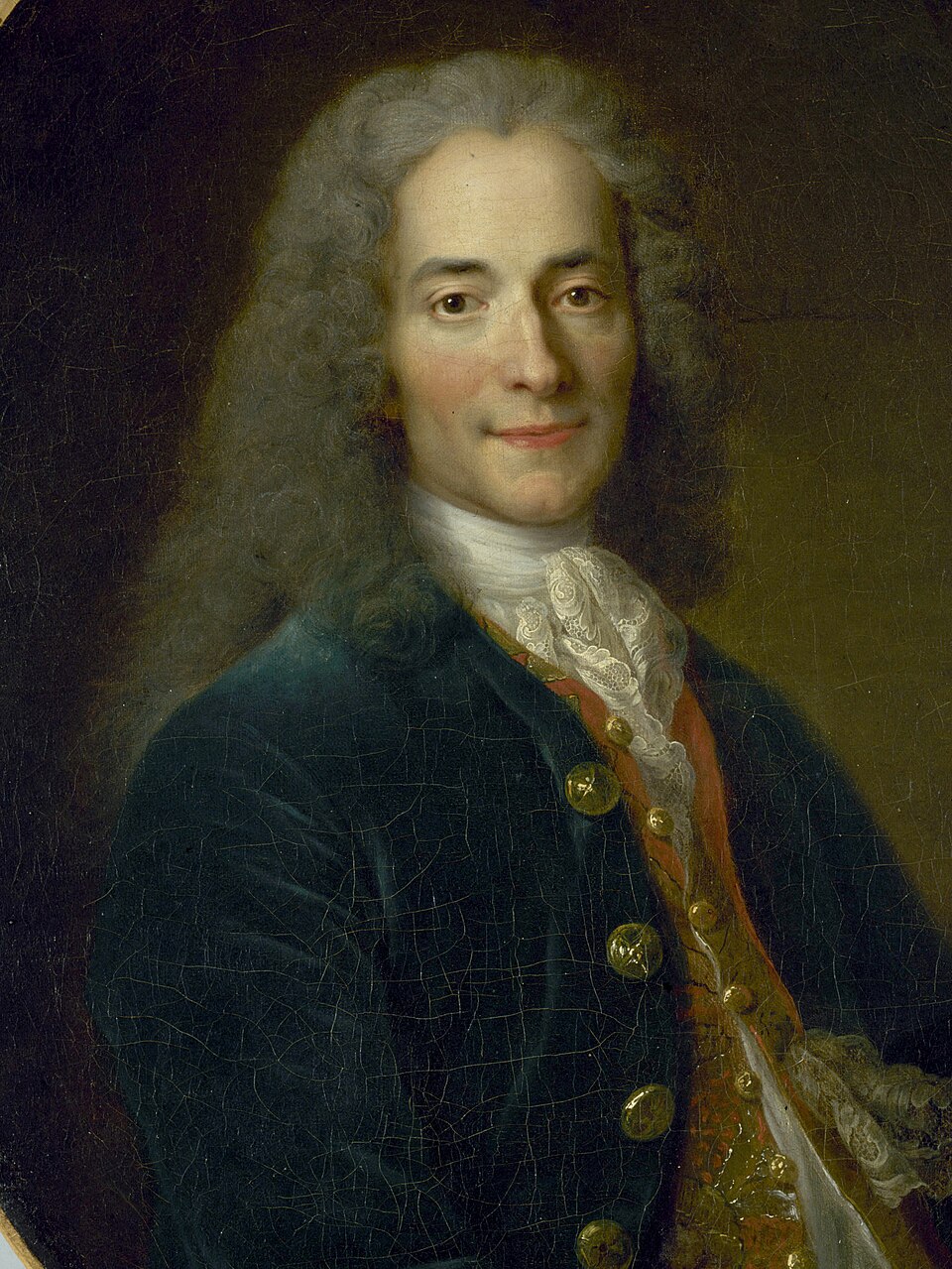
Voltaire (1694 – 1778) was a towering figure in France and world history, widely celebrated as Enlightenment Writer, Philosopher, Historian & Satirist. Their transformative contributions left an enduring imprint on human civilization.
At a Glance: Voltaire
The Lion of the Enlightenment: Voltaire's Indomitable Legacy
On November 21, 1694, Paris saw the birth of François-Marie Arouet, universally known by his nom de plume Voltaire. For more than six decades of prolific literary combat, Voltaire deployed devastating satire, historical scholarship, and moral crusades to challenge the arbitrary abuses of the Ancien Régime, dismantle religious fanaticism, and lay the intellectual groundwork for modern constitutional democracy and human rights.
1. Bastille Imprisonment and the English Epiphany
Born into a prosperous bourgeois family, Voltaire rejected his father's attempts to steer him into the legal profession. Imprisoned in the Bastille for eleven months in 1717 for satirical verses mocking the Regent Philippe II of Orléans, he drafted his epic tragedy Oedipe in his cell. Following an altercation with the arrogant Chevalier de Rohan in 1726, he was forced into exile in England.
This British exile transformed him from a brilliant court wit into a revolutionary philosopher. Immersing himself in the constitutional monarchy, religious pluralism, and empirical science of Isaac Newton and John Locke, Voltaire recognized that religious diversity produced social harmony rather than chaos. His 1734 Lettres philosophiques stunned France by boldly declaring that commerce, science, and religious tolerance were the true foundations of civilization.
2. Cirey, Émilie du Châtelet, and Scientific Revolution
Fleeing French warrants, Voltaire found refuge at Cirey in Champagne with the brilliant mathematician and physicist Émilie du Châtelet. For fifteen years, the couple conducted cutting-edge physics experiments, translated Newton's Principia into French with extensive commentary, and authored foundational histories. Du Châtelet's rigorous mathematical mind disciplined Voltaire's sweeping literary impulses, making Cirey one of the intellectual capitals of eighteenth-century Europe.
3. Candide: Dismantling Leibnizian Optimism
In November 1755, a catastrophic earthquake leveled Lisbon, killing tens of thousands on All Saints' Day. Horrified that theologians and philosophers like Gottfried Wilhelm Leibniz claimed this was 'the best of all possible worlds', Voltaire answered with his 1759 masterpiece, Candide, ou l'Optimisme.
Through the harrowing global misadventures of young Candide and his tutor Pangloss, Voltaire ruthlessly exposed the cruelty of the Inquisition, the horrors of warfare, and the callousness of philosophical fatalism. The novella's closing line—'Il faut cultiver notre jardin' ('We must cultivate our garden')—became a timeless manifesto for pragmatic human action over passive metaphysical resignation.
4. The Ferney Patriarch: Crusader for Human Rights
In his sixties, Voltaire established an independent estate at Ferney on the Franco-Swiss border, becoming the 'Patriarch of Ferney'. When Jean Calas, a Protestant merchant of Toulouse, was falsely accused of murdering his Catholic son and tortured to death on the wheel in 1762, Voltaire took up the family's defense. Deploying letters across Europe, he authored the landmark Treatise on Tolerance (1763), successfully overturning the conviction and rehabilitating the Calas family name.
Voltaire's Major Philosophical Milestones
| Milestone / Work | Year | Primary Genre / Contribution | Historical Impact |
|---|---|---|---|
| Lettres philosophiques | 1734 | Empirical & Political Essays | Popularized British constitutionalism and Newtonian science across Europe. |
| Candide | 1759 | Satirical Picaresque Novella | Demolished blind theological optimism; one of the most widely read books in world literature. |
| Treatise on Tolerance | 1763 | Human Rights Manifesto | Established secular tolerance as a fundamental principle of international law. |
| Dictionnaire philosophique | 1764 | Encyclopedic Critique | Mounted an uncompromising attack on fanaticism, state censorship, and superstition. |
5. Enduring Legacy: The Pen as a Weapon of Liberty
When Voltaire returned to Paris in 1778 at age eighty-three, he was greeted by ecstatic crowds as the savior of human dignity. Dying on May 30, 1778, his coffin was enshrined in the Panthéon in 1791 with the inscription: 'Poet, historian, philosopher, he made the human mind take a great step forward.' His life remains a permanent reminder that satire, critical reason, and moral courage are humanity's greatest shields against tyranny.
Key Milestones, Works & Enduring Achievements
Throughout an extraordinary journey, Voltaire established landmark milestones that continue to inspire scholars, creators, and leaders:
- Candide, ou l'Optimisme (1759) [Satirical Picaresque Novella]: Devastating critique of theological optimism and hypocrisy, concluding with the famous advice to 'cultivate our garden'.
- Treatise on Tolerance (Traité sur la tolérance) (1763) [Philosophical Treatise]: Passionate defense of freedom of religious conscience and universal human rights, written during the Jean Calas affair.
- Letters on the English (Lettres philosophiques) (1734) [Political & Philosophical Essays]: Introduced British constitutionalism, religious pluralism, and Newtonian empirical science to continental Europe.
- Dictionnaire philosophique (1764) [Encyclopedic Treatise]: Series of razor-sharp philosophical articles attacking religious fanaticism, superstition, and state tyranny.
- The Age of Louis XIV (Le Siècle de Louis XIV) (1751) [Historical Masterwork]: Pioneered modern cultural historiography by focusing on arts, commerce, and human reason rather than mere military battles.
Enduring Philosophy & Timeless Words
Reflecting on human nature, duty, and excellence, Voltaire also observed:
Read All Curated Quotes & Tributes
Explore our comprehensive collection of inspiring quotes, personal reflections, and historical tributes honoring Voltaire on November 21.

