🇺🇸 United States
Monday, October 19, 2026
Birthdays Hub Sir Syed Ahmad Khan Profile • 6 min read • 1,724 views • 7 Sections

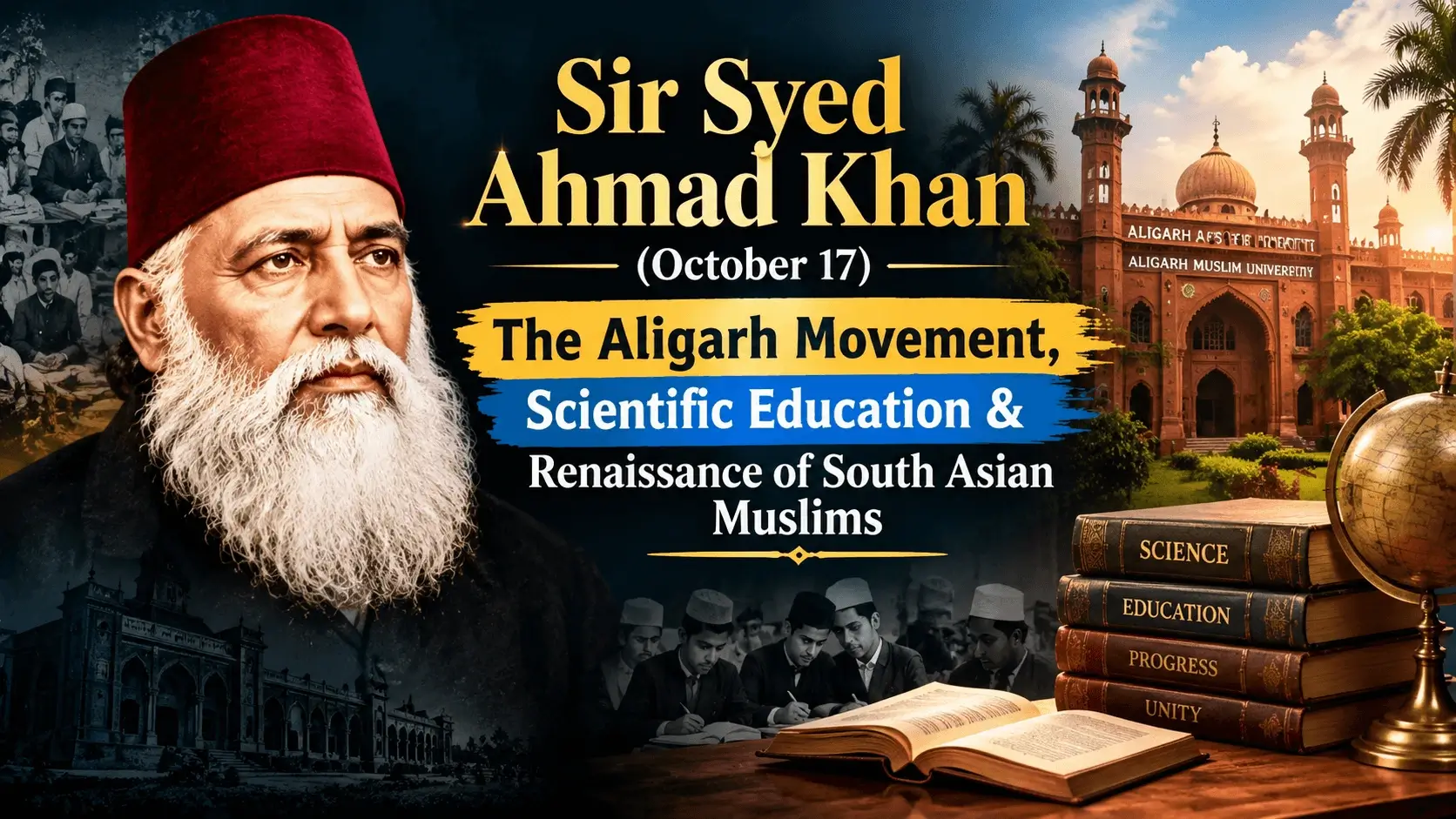
Sir Syed Ahmad Khan (October 17): The Aligarh Movement, Scientific Education & Renaissance of South Asian Muslims

Celebrating Sir Syed Day on October 17: explore the definitive biography of Sir Syed Ahmad Khan, from 1857 and the Scientific Society to the founding of Aligarh Muslim University, Hindu-Muslim unity, and modern education.

Wishes Ideas Desk
Published on October 16, 2026
Sir Syed Ahmad Khan (October 17): The Aligarh Movement, Scientific Education & Renaissance of South Asian Muslims Wishes, Quotes, Greeting Card & Visual Ideas (2026)

Every year on October 17, millions of alumni, scholars, and citizens across the globe celebrate Sir Syed Day in honor of the birthday of Sir Syed Ahmad Khan (born October 17, 1817). A visionary educator, philosopher, and social reformer, Sir Syed was the architect of the Aligarh Movement and the founder of the Muhammadan Anglo-Oriental College (now Aligarh Muslim University). In the darkest hour following the 1857 War of Independence, he single-handedly illuminated the path of modern scientific learning, rationalism, and institutional renewal for South Asian Muslims.

1. A Mughal Aristocracy in Twilight: Delhi & The 1857 Watershed

Sir Syed was born into a distinguished aristocratic family in Delhi with deep hereditary ties to the Mughal court of Akbar II. Raised under the refined guidance of his mother, Aziz-un-Nisa Begum—a woman of extraordinary moral intellect—young Syed was trained in classical Arabic, Persian, mathematics, and Islamic jurisprudence. Rejecting nominal court sinecures, he joined the judicial administration of the East India Company in 1838, rising through merit to become a respected sub-judge.

The turning point of his life arrived with the catastrophic Indian Rebellion of 1857. Witnessing the brutal destruction of Delhi, the slaughter of civilians, and the complete economic, social, and cultural disenfranchisement of the Muslim community, Sir Syed was devastated. Rather than succumbing to despair or retreating into reactionary isolation, Sir Syed arrived at a profound realization: South Asian Muslims had fallen behind not because of military defeat, but because they had willfully shut their doors to modern scientific inquiry, English education, and institutional governance.

2. The "Causes of the Indian Revolt": Truth to Power

In 1858, amid severe British martial retribution, Sir Syed authored a breathtakingly courageous political treatise: Asbab-e-Baghawat-e-Hind (The Causes of the Indian Revolt). Rather than pandering to colonial authorities, Sir Syed boldly laid the blame for the rebellion squarely at the feet of the British administration's arrogance, ignorance of native culture, and total exclusion of Indians from legislative councils.

He argued that when a government denies its citizens legislative representation, public grievances ferment in the dark until they explode in armed revolt. Circulated among members of the British Parliament in London, the treatise directly influenced the passage of the Indian Councils Act of 1861, which introduced native representation into Indian governance. It established Sir Syed as an incorruptible statesman capable of speaking uncompromising truth to imperial power.

3. The Aligarh Movement & The Scientific Society (1864)

Sir Syed recognized that political power without scientific and intellectual capability was a hollow illusion. In 1864, while stationed in Ghazipur, he founded the Scientific Society of Aligarh—the first organization of its kind in India. The society brought together British and Indian scholars to translate major European scientific treatises on physics, mechanics, agriculture, and history into Urdu, democratizing modern knowledge for the Indian public.

In 1869, Sir Syed accompanied his son Syed Mahmood to England, visiting Oxford and Cambridge Universities. Stunned by the intellectual rigor, residential community, and moral discipline of British colleges, Sir Syed wrote home with passionate urgency: "The natives of India, high and low, merchants and shopkeepers, educated and illiterate, when contrasted with the English in education, manners, and uprightness, are like a dirty animal in comparison with a beautiful man. Until the education of our people reaches this level, we can never hold our heads high."

4. Founding the Muhammadan Anglo-Oriental College (1875)

Returning to India, Sir Syed began fundraising tirelessly, facing bitter condemnation and even religious fatwas from conservative clerics who accused him of heresy for advocating English education and Western science. Undeterred, Sir Syed collected donations from wealthy nawabs, Hindu maharajas, and ordinary citizens. In 1870, he launched the pioneering reform journal Tahzibul Akhlaq (Mohammedan Social Reformer) to wage intellectual war against superstitious customs, fatalism, and social inertia.

On May 24, 1875, Sir Syed established the school in Aligarh, and on January 8, 1877, Viceroy Lord Lytton laid the foundation stone of the Muhammadan Anglo-Oriental (MAO) College. In his historic address, Sir Syed articulated his immortal dream: "From the seed which we sow today, there may spring up a mighty tree, whose branches, like those of the banyan of the earth, shall strike firm roots into the soil, and send forth fresh and vigorous saplings, to shade and shelter students from all over the world." In 1920, the college was elevated to the status of a central university, flourishing today as Aligarh Muslim University (AMU).

5. Hindu-Muslim Unity: "The Two Eyes of a Beautiful Bride"

Sir Syed was an ardent early champion of communal fraternity. In a legendary speech delivered at Gurdaspur in 1884, he articulated an unforgettable metaphor for Indian nationhood:

“
"India is like a beautiful bride, and Hindus and Muslims are her two radiant eyes. If one of them is harmed, the bride is disfigured; if both are healthy, she is beautiful beyond measure. We inhabit the same land, are subject to the same rule, breathe the same air, and drink from the same sacred rivers."
Heartfelt Wish
Share

He actively admitted Hindu students to MAO College from its inception; the first graduate of Aligarh was Ishwari Prasad, a Hindu student, and the college's first mathematics professor was Lala J.C. Chakravarti. Sir Syed consistently maintained that modern education was a universal right belonging to all children of the soil.

6. Asar-us-Sanadid: The Scholar of Archaeology and Heritage

Long before his educational triumphs, Sir Syed established himself as a world-class archaeologist and historian. In 1847, he published Asar-us-Sanadid (Monuments of Delhi), an extraordinary 600-page illustrated archaeological survey documenting every historical mosque, temple, fort, and tomb in and around Delhi. Sir Syed personally climbed the scaffolding of the Qutub Minar in a swinging basket to sketch its ancient inscriptions by hand.

The work earned him international acclaim: the Royal Asiatic Society of Great Britain elected him an honorary member, and the French orientalist Garcin de Tassy translated it into French. Sir Syed demonstrated that a true modernist does not discard his cultural heritage, but studies it with scientific rigor and profound reverence.

7. The Immortal Legacy of Sir Syed Ahmad Khan

Sir Syed passed away in Aligarh on March 27, 1898, and was interred within the grounds of the AMU Jama Masjid, where thousands visit his resting place daily. On October 17, the worldwide Aligarh fraternity celebrates Sir Syed Day with traditional commemorative dinners, scholarly symposiums, and the stirring recitation of the university anthem.

Sir Syed Ahmad Khan transformed a defeated, backward-looking community into confident, articulate leaders of modern science, civil administration, and constitutional democracy. He taught that reason is the ally of faith, and that the only true weapon against oppression is the enlightenment of the classroom. Humanity honors him as one of the greatest renaissance figures in South Asian history.


Heartfelt Quotes & Messages

Direct 1-click copy and share for WhatsApp, SMS & Social Media.

50 Quotes & Messages
#1 • Quotes Collection 50+ Quotes
Sir Syed Ahmad Khan

50+ Best Sir Syed Ahmad Khan Quotes, Sir Syed Day Wishes & Educational Wisdom (2026)

Discover 50+ memorable quotes by Sir Syed Ahmad Khan on modern scientific education, rational inquiry, Hindu-Muslim unity, and civic reform celebrating his October 17 birth anniversary.

Sir Syed's revolutionary advocacy for modern sciences, rationalism, and intellectual enlightenment.

#01 “Acquisition of knowledge of all subjects, especially science and modern technology, is incumbent upon every Muslim.”
#02 “The first and foremost duty of a civilized person is to cultivate the intellect through modern scientific education.”
#03 “Do not show the face of Islam to others; show your own face as the true follower of Islam educated in modern sciences.”
#04 “Ignorance is the root cause of the political, economic, and moral downfall of our people.”
#05 “A nation that rejects modern scientific progress condemns its future generations to perpetual servitude.”
#06 “Let us have science in our right hand, philosophy in our left, and the crown of faith on our head.”
#07 “Knowledge is an inheritance belonging to the whole human race; take it wherever you find it without prejudice.”
#08 “The main reason for the backwardness of Muslims is that they have kept away from the modern sciences.”
#09 “We need institutions where our young people can learn the latest discoveries of physics, chemistry, and statecraft.”
#10 “Faith without reason degenerates into superstition; reason enlightened by faith leads to human dignity.”

Historic statements championing communal harmony, tolerance, and brotherhood between communities.

#01 “India is like a beautiful bride, and Hindus and Muslims are her two radiant eyes. If one is harmed, the bride is disfigured.”
#02 “We inhabit the same land, are subject to the same rule, breathe the same air, and drink from the same sacred rivers.”
#03 “Remember that the words "Hindu" and "Muslim" are only meant for religious distinction; otherwise, all people who live in this country belong to one and the same nation.”
#04 “No country can become prosperous and strong when its communities harbor hatred and suspicion toward one another.”
#05 “True patriotism demands that we seek the welfare, progress, and elevation of all citizens irrespective of creed.”
#06 “Tolerance of opposing viewpoints is the hallmark of an educated, civilized, and noble mind.”
#07 “Do not allow narrow sectarian prejudices to obscure the grand vision of a united, enlightened motherland.”
#08 “When we work together in mutual trust, no obstacle on earth can prevent the progress of our motherland.”
#09 “Coexistence is not merely a political necessity; it is a sacred moral duty commanded by common humanity.”
#10 “Let our hearts be wide enough to embrace every fellow countryman with sincere affection and goodwill.”

Exhortations on work ethic, dignity of labor, integrity, and abandoning destructive customs.

#01 “Self-help is the only true foundation of genuine and lasting national progress.”
#02 “Rely upon your own arms and intelligence; those who depend on others remain permanent beggars in history.”
#03 “A nation's character is determined not by the words of its leaders, but by the private moral integrity of its citizens.”
#04 “Abandon false aristocratic pride and fatalistic lethargy; dignity resides in honest labor and scientific effort.”
#05 “Women's education is indispensable; an uneducated mother cannot raise enlightened, courageous children.”
#06 “Do not waste your precious resources on frivolous ceremonies and ostentatious weddings while your schools languish.”
#07 “Truth requires courage; do not hesitate to speak the truth even when it offends entrenched orthodoxy.”
#08 “The real reformer is one who points out the shortcomings of his own people with love and determination to heal.”
#09 “Poverty of the mind is a far greater tragedy than poverty of the purse.”
#10 “Work unceasingly; time is the most precious capital that God has entrusted to mortal man.”

Words outlining the founding purpose of MAO College and the mission of youth leadership.

#01 “From the seed we sow today, there may spring up a mighty tree whose branches shall shelter students from all over the world.”
#02 “Aligarh was founded not merely to grant degrees, but to build moral character, national leaders, and independent thinkers.”
#03 “O young students of Aligarh, go forth into the world with the light of modern learning and the shield of unblemished integrity.”
#04 “The purpose of education is to produce free, responsible citizens capable of serving their community and country.”
#05 “Let the students of this institution be known not for arrogance, but for humility, public service, and scientific inquiry.”
#06 “I have founded this college with tears and sweat; guard its noble ideals as your most sacred inheritance.”
#07 “An educated youth who does not use his learning to uplift his impoverished brethren has wasted his education.”
#08 “Let Aligarh remain a beacon of intellectual freedom where all truth is sought without fear or favor.”
#09 “Strive for excellence in every field; mediocrity is an insult to the noble intellect God has granted you.”
#10 “The future of our nation depends upon the character and vision cultivated within these classrooms.”

Commemorative greetings and reflections celebrating Sir Syed Day on October 17.

#01 “Happy Sir Syed Day! On October 17, we pay heartfelt homage to the visionary educator who unlocked the doors of modern learning for millions.”
#02 “To all Aligs and education lovers across the globe: Happy Sir Syed Day! May the spirit of inquiry and enlightenment guide your journey.”
#03 “Honoring Sir Syed Ahmad Khan on his 209th birth anniversary—the statesman who proved that pen and knowledge are mightier than empires.”
#04 “May the flame of education kindled at Aligarh continue to banish the darkness of ignorance, prejudice, and despair worldwide.”
#05 “On Sir Syed Day, let us reaffirm our commitment to scientific inquiry, rationalism, communal brotherhood, and educational equity.”
#06 “Remembering the father of the Aligarh Movement: thank you, Sir Syed, for teaching us that progress begins in the classroom.”
#07 “A salute to the visionary whose courage transformed a defeated community into articulate, confident, and modern global citizens.”
#08 “Wishing a joyous and reflective Sir Syed Day to students, teachers, and scholars everywhere. May your pursuit of truth be unceasing.”
#09 “Let us celebrate October 17 by supporting underprivileged students and ensuring that quality education reaches the humblest home.”
#10 “Sir Syed's mission was not merely for a century, but for eternity: an educated, moral, and united society. Happy Sir Syed Day 2026!”
Spread the Celebration & Joy!
Copy heartfelt wishes or share directly on WhatsApp and social media.
WhatsApp
Wishes Ideas Desk

Curating heartfelt words, emotional messages, and celebratory inspiration for life's most cherished bonds and milestones.

Wish copied to clipboard! ✨