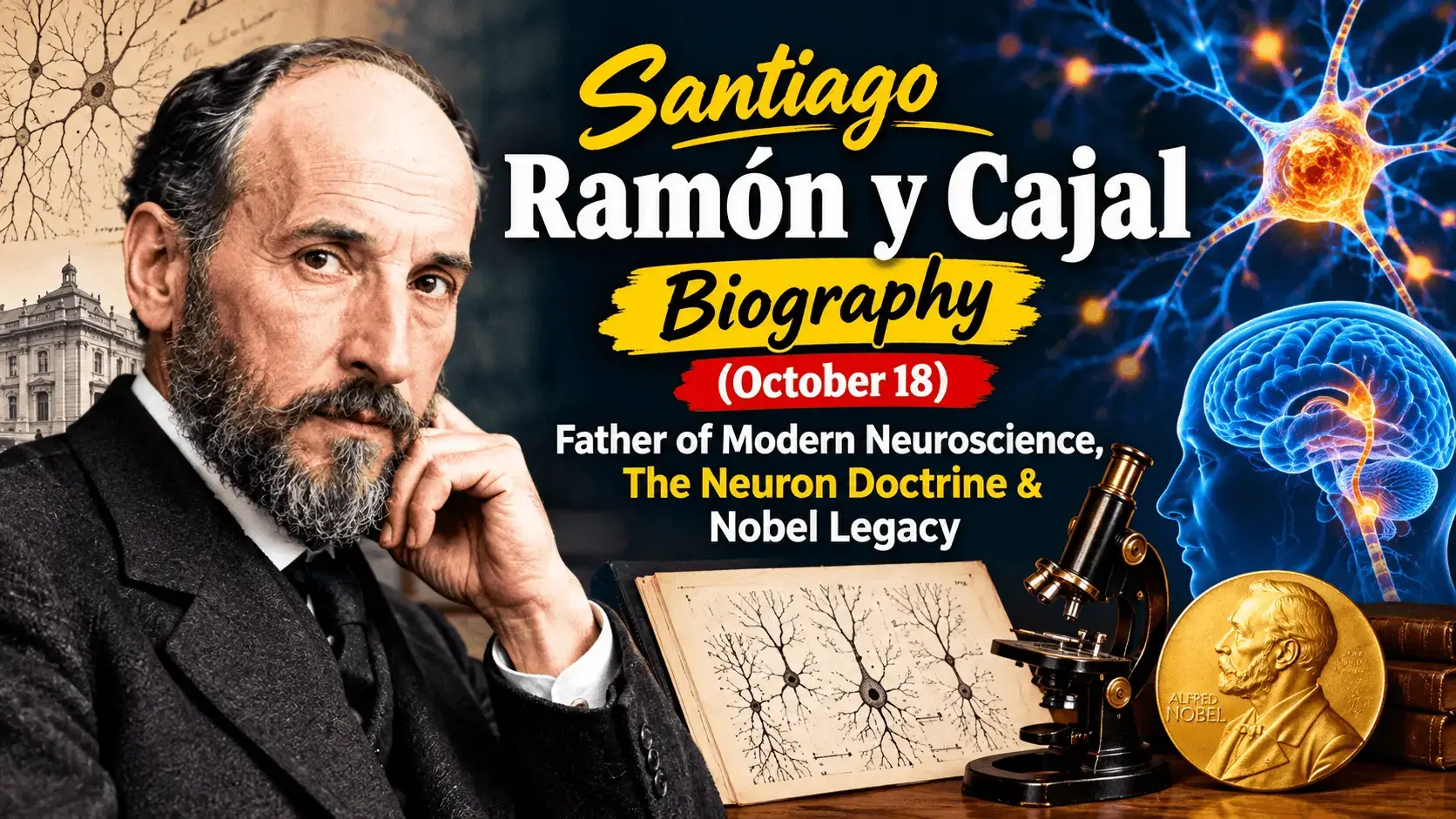
On October 18, 1934, died Santiago Ramón y Cajal—the Spanish neuroanatomist, Nobel laureate, artist, and visionary polymath universally revered as the "Father of Modern Neuroscience." Working in intellectual isolation in nineteenth-century Spain with modest monocular microscopes, Cajal combined revolutionary histological staining techniques with breathtaking artistic draftsmanship to demonstrate the foundational principle of brain biology: the Neuron Doctrine. Cajal proved that the central nervous system is not a continuous, diffuse web (reticulum), but is composed of billions of individual, contiguous cells called neurons that communicate across microscopic gaps. His exquisite anatomical drawings of the cerebral cortex, retina, and cerebellum remain as indispensable to modern brain science today as they were over a century ago.
1. The Rebellious Artist of Petilla de Aragón: From Truant to Anatomist (1852–1887)
Santiago Ramón y Cajal was born on May 1, 1852, in the remote Aragonese village of Petilla de Aragón, Spain. His father, Justo Ramón Casasús, was an ambitious barber-surgeon who later became a licensed physician and professor of anatomy. Young Santiago was a fiercely independent, rebellious boy with a passionate obsession for drawing, nature, and gymnastics. He filled walls, church doors, and notebooks with sketches, much to the exasperation of his father, who viewed visual art as a frivolous distraction and confiscated his pencils, apprenticing him successively to a barber and a cobbler to discipline him.
However, when Justo took his teenage son to desolate churchyards at night to disinter human skeletons for anatomical study, Cajal was mesmerized by the complex osteological architecture of the human skeleton. Cajal realized that his artistic gifts could be united with medicine. He entered the University of Zaragoza to study medicine, graduating in 1873. Following military service as a medical officer in the grueling, malaria-infested swamps of Cuba during the Ten Years' War, Cajal returned to Spain severely ill with malaria and tuberculosis, convalescing in the Pyrenees before earning his medical doctorate in Madrid in 1877.
2. The Epiphany of the Silver Stain: Golgi's Reaction and The Madrid Laboratory
In 1887, while serving as Professor of Anatomy at the University of Valencia, Cajal visited the Madrid laboratory of psychiatrist Luis Simarro Lacabra. Simarro demonstrated a mysterious, unpredictable histological staining technique recently discovered by Italian anatomist Camillo Golgi: the reazione nera (black reaction), which used silver nitrate to deposit black silver chromate crystals inside nervous tissue.
At the time, the brain was an impenetrable microscopic jungle. Conventional stains colored all cellular components simultaneously, resulting in a dark, indistinct blur under the microscope. Golgi's silver chromate method possessed a miraculous property: it stained only one to two percent of neurons in a given brain section, but it stained those few cells entirely, including their microscopic dendrites, axons, and terminal boutons, silhouetting them against a clear, amber-yellow background.
Cajal was electrified. He described the moment as a divine revelation: "A magnificent sight! Against a translucent yellow background, slender black filaments appeared, smooth and delicate, or studded with spines; bodies triangular, stellate, fusiform; all drawn with the sharpness of a Chinese ink drawing on Japanese paper." Returning to his modest laboratory, Cajal perfected the technique by adopting the ontogenetic method: studying embryonic and young animal brains where myelin was not yet fully formed, allowing him to trace nerve fibers from their origins to their ultimate destinations with crystalline clarity.
3. The Neuron Doctrine: Overthrowing Reticular Theory
At the time, the dominant consensus in European physiology was the Reticular Theory, championed by Joseph von Gerlach and Camillo Golgi himself. Reticularists believed that the nervous system was a continuous, physically interconnected syncytial meshwork or web through which electrical currents flowed without cellular boundaries. The brain was considered an exception to Matthias Schleiden and Theodor Schwann's universal Cell Theory.
Between 1888 and 1892, working alone in Barcelona and Madrid, Cajal published an avalanche of pioneering papers that dismantled Reticular Theory. Cajal demonstrated conclusively that:
- Individual Neurons: Every nerve cell is an independent anatomical, physiological, and genetic unit. Neurons do not fuse into a continuous net; they terminate in free endings that touch or lie adjacent to other cells across microscopic gaps (named "synapses" by Sir Charles Sherrington in 1897).
- Law of Dynamic Polarization: Cajal formulated the fundamental functional law of the nervous system: nerve impulses travel in one direction only, entering the neuron through its branching dendrites and cell body (receptive poles) and exiting through its single, elongated axon (transmitting pole).
- The Axonal Growth Cone: Cajal discovered the conical, motile tip at the end of growing nerve fibers (the growth cone), describing it as an active biological battering ram endowed with chemical sensitivity that seeks its synaptic target during embryonic development.
- Dendritic Spines: Cajal identified the tiny, mushroom-like projections decorating dendrites, correctly hypothesizing that they represent specialized points of interneuronal communication.
4. The Nobel Prize of 1906: The Clash of Scientific Visions in Stockholm
In October 1889, determined to convince a skeptical European scientific establishment, Cajal packed his microscope and histology slides and traveled at his own expense to the Congress of the German Anatomical Society in Berlin. He cornered Europe's leading anatomists—most notably the Swiss master Albert von Kölliker—compelling them to look through his lenses. Kölliker looked, was stunned by the incontrovertible clarity of the silver preparations, and immediately announced his conversion to Cajal's Neuron Doctrine, translating Cajal's papers into German.
In 1906, Santiago Ramón y Cajal and Camillo Golgi were jointly awarded the Nobel Prize in Physiology or Medicine for their monumental contributions to the structure of the nervous system. The award ceremony in Stockholm produced one of the most dramatic ideological clashes in scientific history. Golgi delivered a rigid, dogmatic Nobel lecture stubbornly defending his discredited Reticular Theory and attacking the neuron concept. When Cajal took the podium the following day, he delivered a masterclass of empirical elegance, systematically presenting twenty years of microscopic evidence proving the Neuron Doctrine. The international scientific community unanimously embraced Cajal's vision, cementing his position as the father of modern brain science.
5. "Butterflies of the Soul": Scientific Artistry and Advice for Young Investigators
Cajal was not merely a brilliant scientist; he was an artistic genius. Because photographic technology at the time could not capture the multiple focal depths of three-dimensional brain tissue, Cajal observed slides with his left eye through the microscope while drawing with his right hand on paper. Over his lifetime, he produced more than 3,000 breathtaking, pen-and-ink illustrations of cortical pyramidal cells, cerebellar Purkinje cells, and retinal circuits that are exhibited today in major art museums worldwide. Cajal poetically described cortical neurons as the "butterflies of the soul, whose beating of wings may one day clarify the secret of mental life."
In his 1897 classic book, Reglas y Consejos sobre Investigación Científica (Advice for a Young Investigator), Cajal laid down timeless rules for scientific pursuit. He argued that monumental discoveries do not require extraordinary genius or lavish laboratories, but passionate curiosity, unyielding persistence, and mental independence from established dogmas. Cajal famously declared: "Every man can, if he so desires, become the sculptor of his own brain."
Santiago Ramón y Cajal passed away in Madrid on October 18, 1934, at the age of eighty-two, working on scientific revisions of his memoirs until his final days. Today, as neuroscientists map the human connectome and engineer brain-computer interfaces, they stand on the unshakeable foundation built by the Spanish master with a microscope and a pen.
6. Frequently Asked Questions (FAQ) About Santiago Ramón y Cajal
When did Santiago Ramón y Cajal die and where?
Santiago Ramón y Cajal died on October 18, 1934, at his home in Madrid, Spain, at the age of eighty-two. He is buried in the Almudena Cemetery in Madrid.
Why is Cajal called the "Father of Modern Neuroscience"?
Cajal proved the Neuron Doctrine—the fundamental truth that the nervous system is composed of individual, contiguous cells (neurons) rather than a continuous fused net. He discovered the axonal growth cone, dendritic spines, and formulated the Law of Dynamic Polarization governing how electrical impulses travel through brain circuits.
When did Cajal win the Nobel Prize?
Santiago Ramón y Cajal won the Nobel Prize in Physiology or Medicine in 1906, shared jointly with Italian anatomist Camillo Golgi, "in recognition of their work on the structure of the nervous system."
What was the famous disagreement between Cajal and Camillo Golgi?
Golgi championed the Reticular Theory, arguing the brain was a single continuous physical network. Cajal utilized Golgi's own silver stain method to prove the opposite: the Neuron Doctrine, demonstrating that neurons are independent, separated units communicating across microscopic gaps.