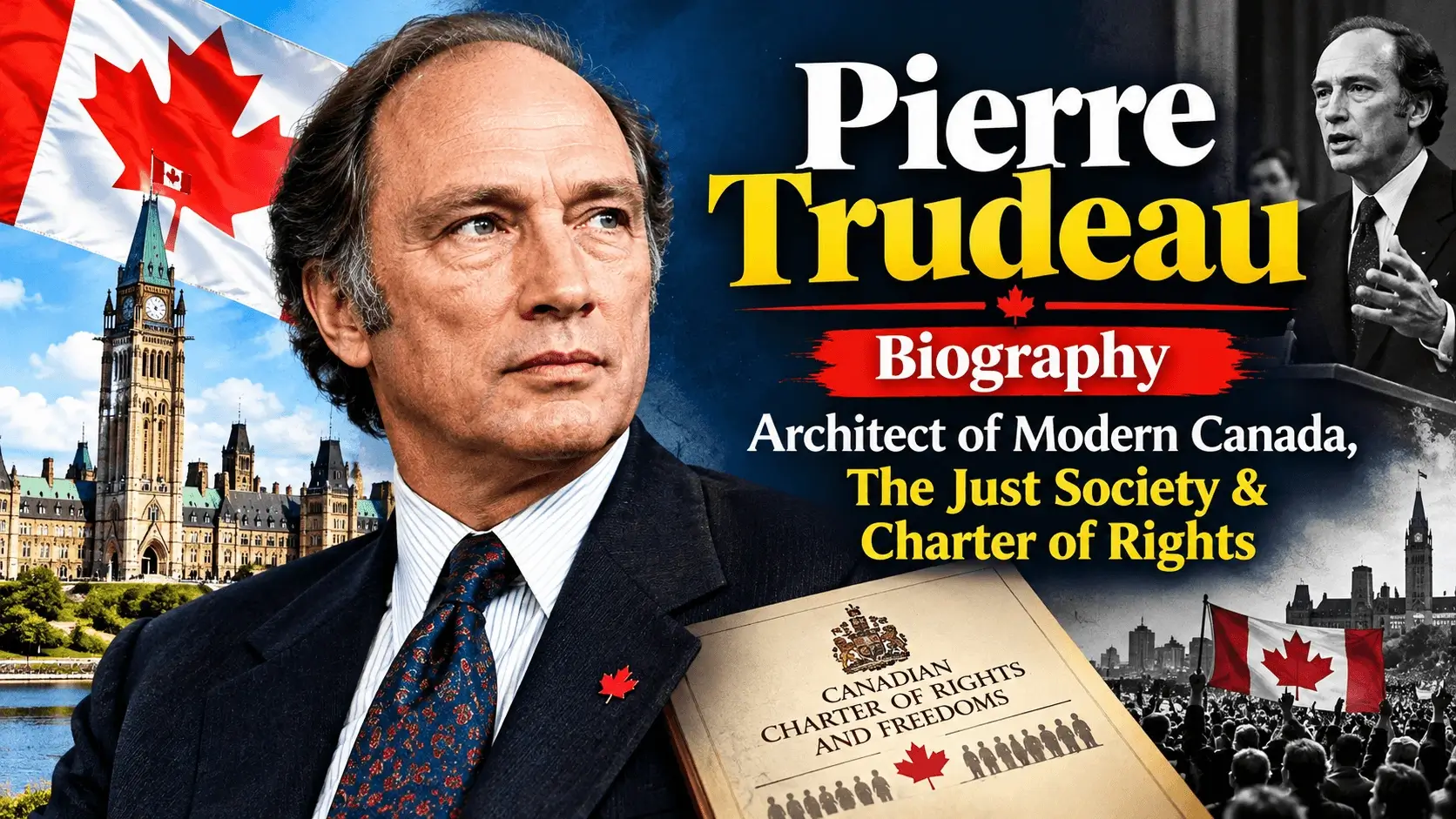
Born on October 18, 1919, in Montreal, Pierre Elliott Trudeau served as the 15th Prime Minister of Canada for nearly sixteen years (1968–1979, 1980–1984), fundamentally shaping the legal, cultural, and political identity of the modern nation. With his razor-sharp intellect, sartorial elegance (marked by his signature red lapel rose), and unapologetic defense of federalism, Trudeau swept to power on a wave of popular excitement known as "Trudeaumania." As the visionary champion of the "Just Society," he introduced official bilingualism, established the world's first national policy of multiculturalism, and successfully patriated the Canadian Constitution with its landmark Charter of Rights and Freedoms in 1982.
1. The Intellectual Bohemian: Montreal, Harvard & Global Travels (1919–1965)
Pierre Trudeau was born to a wealthy French-Canadian entrepreneur father, Charles-Émile Trudeau, and a mother of Scottish-French descent, Grace Elliott. Growing up bilingual in prestigious Jesuit schools like Collège Jean-de-Brébeuf, Trudeau cultivated an intense intellectual discipline paired with a rebellious non-conformity. He earned a law degree from the Université de Montréal, a master's in political economy from Harvard University, and pursued doctoral research at the London School of Economics under legendary socialist thinker Harold Laski.
In 1948–1949, Trudeau embarked on a perilous solo journey across war-torn Europe, the Middle East, Pakistan, India, China, and Indochina, observing anticolonial rebellions and developing an abiding commitment to universal human rights. Returning to Quebec, he co-founded the influential dissident intellectual journal Cité Libre in 1950, leading the intellectual resistance against the authoritarian, clerical regime of Premier Maurice Duplessis during Quebec's pivotal "Quiet Revolution."
2. Justice Minister to "Trudeaumania": Decriminalization & The Just Society
Persuaded to enter federal politics by Prime Minister Lester B. Pearson in 1965, Trudeau was appointed Minister of Justice in 1967. He stunned the nation by introducing sweeping legal reforms that modernized Canada's Criminal Code, legalizing divorce, decriminalizing contraception and homosexuality, and establishing lotteries. Defending his reforms on national television, Trudeau uttered his immortal phrase: "There's no place for the state in the bedrooms of the nation."
When Pearson retired in 1968, the charismatic, pirouetting Trudeau won the Liberal leadership. The June 1968 federal election triggered a social phenomenon called "Trudeaumania": crowds mobbed him like a rock star, young voters embraced his youthful optimism, and he secured a decisive majority under the banner of creating a "Just Society"—a vision where individual rights, constitutional equality, and state compassion ensured opportunity for every citizen.
3. The 1970 October Crisis & Defending Canadian Federalism
Trudeau's leadership faced its supreme crisis in October 1970 when the terrorist group Front de libération du Québec (FLQ) kidnapped British diplomat James Cross and murdered Quebec Labour Minister Pierre Laporte. In response to requests from Montreal civic and Quebec provincial authorities, Trudeau made the controversial decision to invoke the wartime War Measures Act to suspend civil liberties and restore public safety. When a reporter challenged his heavy military presence in Ottawa, Trudeau delivered his defiant, world-famous retort: "Just watch me."
Throughout his tenure, Trudeau fought tenaciously against Quebec separatism. In the historic 1980 Quebec Referendum, Trudeau delivered impassioned speeches promising constitutional renewal while warning that sovereignty-association would fragment the nation's shared destiny. His persuasive federalist vision rallied Quebec voters to decisively reject separation by a 60–40 margin.
4. The Charter of Rights, Official Multiculturalism & Global Diplomacy
Trudeau's crowning domestic achievement arrived on April 17, 1982, when Queen Elizabeth II and Trudeau signed the Proclamation of the Constitution Act in Ottawa, formally severing Canada's legal dependence on the British Parliament (patriation). Central to the new constitution was the Canadian Charter of Rights and Freedoms, guaranteeing fundamental civil liberties, minority language education, and equality before the law.
Equally transformative was his 1971 declaration of Official Multiculturalism, recognizing that Canadian identity flourished not through forced assimilation, but through celebrating the diverse heritages of its immigrant communities. On the international stage, Trudeau pursued an independent foreign policy: opening early diplomatic relations with the People's Republic of China in 1970, maintaining cordial ties with Cuba, and launching a global peace initiative in 1983–1984 to de-escalate nuclear tensions during the Cold War.
5. Explore Profiles & Quotes
Explore more about Prime Minister Pierre Trudeau’s constitutional and political vision:
- View his biographical timeline on Pierre Trudeau's Dedicated Profile Page.
- Explore his memorable quotes, political philosophy, and birthday wishes in our 50+ Best Pierre Trudeau Quotes & Birthday Wishes Collection.
6. Frequently Asked Questions (FAQ) About Pierre Trudeau
What is Pierre Trudeau's most famous quote?
Among his most famous quotes are: "The state has no business in the bedrooms of the nation" (1967) and his defiant reply during the October Crisis, "Just watch me" (1970).
What were Pierre Trudeau's greatest achievements as Prime Minister?
His major achievements include the patriation of the Canadian Constitution with the Charter of Rights and Freedoms (1982), the Official Languages Act (1969), the establishment of official multiculturalism (1971), and defeating the 1980 Quebec sovereignty referendum.
Is Justin Trudeau related to Pierre Trudeau?
Yes, Justin Trudeau, who became Prime Minister of Canada in 2015, is the eldest son of Pierre Elliott Trudeau and his former wife, Margaret Sinclair.


