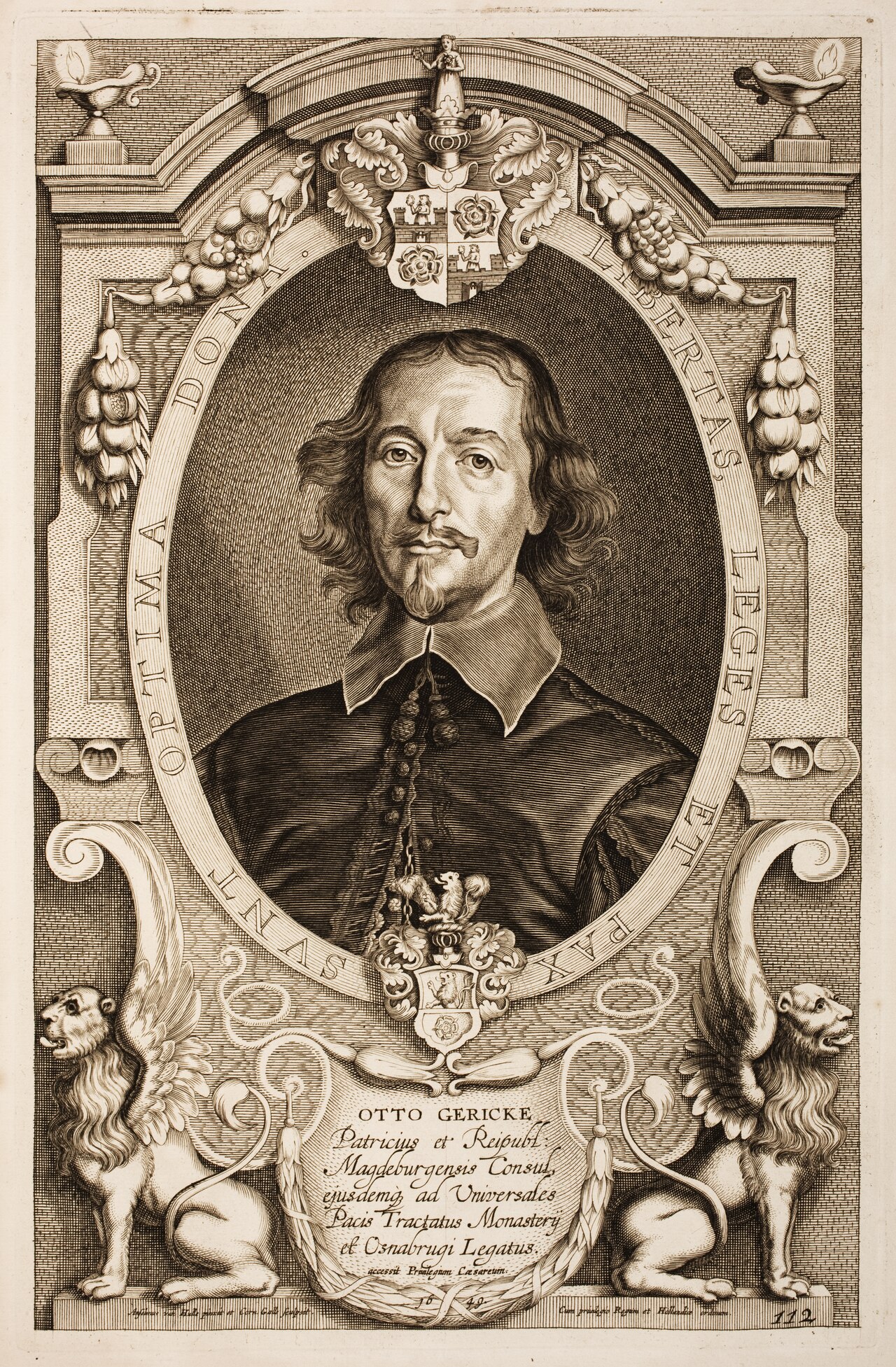
Otto von Guericke (1602 – 1686) was a towering figure in Germany and world history, widely celebrated as Scientist, Inventor, Physicist, Mayor of Magdeburg. Their transformative contributions left an enduring imprint on human civilization.
At a Glance: Otto von Guericke
The Master of the Vacuum and the Ocean of Air
Born on November 20 (O.S. November 30), 1602, in Magdeburg, Otto von Guericke was one of the towering polymaths of the seventeenth-century Scientific Revolution. While serving for three decades as the diplomat and Mayor of Magdeburg—guiding his devastated city back from total destruction during the Thirty Years' War—Guericke conducted empirical physics experiments that shattered nearly two millennia of Aristotelian dogma, proving the reality of the vacuum and revealing the immense, invisible force of atmospheric pressure.
1. The Crucible of the Thirty Years' War and Mayoral Statesmanship
Guericke studied law, mathematics, and fortification engineering at the universities of Leipzig, Helmstedt, Jena, and Leiden. In 1626, he returned to his home city of Magdeburg, only to be plunged into the vortex of the Thirty Years' War. On May 20, 1631, imperial troops under the Count of Tilly stormed the Protestant stronghold; in the ensuing 'Sack of Magdeburg', twenty thousand inhabitants were slaughtered and the entire city was reduced to ash.
Guericke barely escaped with his life, held captive until ransomed. Demonstrating extraordinary civic devotion, he served as military engineer for the Swedish and Saxon crowns before being elected Mayor (Bürgermeister) of Magdeburg in 1646. Over the next thirty years, Guericke attended peace conferences, including the Peace of Westphalia (1648), securing Magdeburg's municipal liberties and masterminding its architectural rebirth.
2. Inventing the Vacuum Pump and Dismantling Aristotle
Since the ancient Greeks, Aristotle's maxim 'horror vacui'—that nature abhors a vacuum—had stood as unchallenged orthodoxy across European universities. Scholars claimed that empty space was physically impossible because nature would instantly rush in to fill any void.
Inspired by Evangelista Torricelli's mercury column experiments, Guericke set out to construct a mechanical device capable of actively pumping air out of a sealed container. After attempting to evacuate a water-filled beer cask (which imploded under external pressure), Guericke fabricated a hollow copper sphere fitted with a piston pump, leather flap-valves, and water-sealed joints in 1650. His invention—the first mechanical vacuum air pump—allowed natural philosophers to manipulate empty space for the first time in human history.
3. The Spectacular Magdeburg Hemispheres Experiment
Guericke was not only a brilliant experimentalist; he was a master of scientific theatre. In May 1654, at the Imperial Diet of Regensburg, he staged a demonstration before Holy Roman Emperor Ferdinand III and the gathered German princes that captivated Europe.
Guericke took two matching hollow copper hemispheres approximately fifty centimeters in diameter, lined the rims with an oiled leather ring to create an airtight seal, and evacuated the interior air using his pump. Hitching two teams of eight draft horses (and in subsequent demonstrations, thirty horses) to opposite sides, the horses strained to pull the hemispheres apart. The hemispheres held together with immense, supernatural rigidity. Only when Guericke opened the stopcock to allow air back inside did the spheres effortlessly separate under their own weight. Guericke demonstrated that it was not 'horror vacui' holding the spheres, but the crushing physical weight of the Earth's atmosphere pushing inward against the empty interior.
4. Electrostatics and the Sulfur Globe
In 1663, Guericke turned his attention to celestial and gravitational phenomena, constructing the world's first friction electrostatic generator. He poured molten sulfur into a hollow glass globe, broke the glass, and mounted the resulting sulfur sphere on an iron axle with a hand crank.
By rotating the sulfur sphere rapidly while rubbing his dry palm against it, Guericke generated substantial charges of static electricity. He was the first to observe electrostatic repulsion (noticing that a feather attracted to the sphere would immediately shoot away and avoid returning) and discovered electrical conduction along linen threads. In darkened rooms, his rotating sulfur globe crackled with visible phosphorescent light—the first recorded observation of man-made electroluminescence.
Otto von Guericke's Pioneering Scientific Milestones
| Discovery / Invention | Year | Experimental Apparatus | Historical Impact on Science |
|---|---|---|---|
| Piston Vacuum Pump | 1650 | Cylinder piston with water seals | Enabled experimental pneumatic physics; basis for Boyle's gas laws. |
| Magdeburg Hemispheres | 1654 | Mating copper hemispheres & horses | Spectacular proof of atmospheric pressure; shattered Aristotelian physics. |
| Water Barometer & Storm Forecast | 1660 | 34-foot vertical glass tube on house wall | Demonstrated barometric pressure drops preceding atmospheric storms. |
| Friction Electrostatic Machine | 1663 | Rotating sulfur sphere with hand crank | Discovered electrostatic repulsion, conduction, and electric luminescence. |
| Experimenta Nova Magdeburgica | 1672 | Comprehensive scientific publication | Directly inspired Boyle, Hooke, Newton, and Papin's steam engine. |
5. The Dawn of the Industrial Age and Legacy
Guericke's groundbreaking treatise, Experimenta Nova (ut vocantur) Magdeburgica de Vacuo Spatio (1672), became an immediate European sensation. Robert Boyle and Robert Hooke built improved versions of Guericke's pump in Oxford, formulating Boyle's Law. Denis Papin and Thomas Newcomen utilized Guericke's insights regarding the power of the atmospheric vacuum against a moving piston to construct the world's first steam engines, igniting the Industrial Revolution.
Otto von Guericke passed away in Hamburg on May 21, 1686, at age eighty-three. His legacy is celebrated at the Otto von Guericke University Magdeburg, named in his honor. Guericke demonstrated that nature's invisible forces can be harnessed by human ingenuity to transform civilization.
Key Milestones, Works & Enduring Achievements
Throughout an extraordinary journey, Otto von Guericke established landmark milestones that continue to inspire scholars, creators, and leaders:
- Invention of the Vacuum Pump (Piston Air Pump) (1650) [Mechanical Invention]: First mechanical apparatus capable of evacuating air from sealed vessels, paving the way for pneumatic physics and steam engine thermodynamics.
- Magdeburg Hemispheres Experiment (1654) [Scientific Demonstration]: Legendary public experiment before Emperor Ferdinand III in Regensburg, where two teams of draft horses could not separate evacuated copper hemispheres.
- First Friction Electrostatic Generator (1663) [Electrical Apparatus]: Rotating sulfur sphere turned by hand that generated static electricity, leading to the discovery of electrostatic repulsion and glow discharge.
- Experimenta Nova Magdeburgica de Vacuo Spatio (1672) [Scientific Treatise]: Magnum opus documenting his vacuum, air pressure, meteorological, and electrostatic experiments, profoundly influencing the European Scientific Revolution.
- Water Barometer and Weather Forecasting (1660) [Meteorological Instrument]: Erected a 34-foot water barometer against his Magdeburg house, using atmospheric pressure drops to successfully forecast severe storms.
Enduring Philosophy & Timeless Words
Reflecting on human nature, duty, and excellence, Otto von Guericke also observed:
Read All Curated Quotes & Tributes
Explore our comprehensive collection of inspiring quotes, personal reflections, and historical tributes honoring Otto von Guericke on November 20.