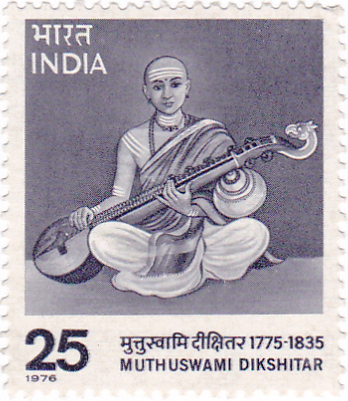
Every year on October 21, the international community commemorates Muthuswami Dikshitar (Carnatic Classical Musical Trinity Composer, Poet, Sanskrit Polymath & Veena Virtuoso). Celebrated across India and worldwide for defining contributions to music, their life remains an inspiring beacon of human courage, vision, and excellence.
1. Early Foundations, Background & Formative Years
Muthuswami Dikshitar was born on March 24, 1775, in Tiruvarur, Tamil Nadu, into a Brahmin family of profound musical lineage. Accompanied by his guru Chidambaranatha Yogi, he spent five formative years in Varanasi (Benares), studying Sanskrit grammar, Vedanta philosophy, Tantra, and Hindustani classical music, absorbing the dignified majesty of the Dhrupad tradition. Returning to South India, Dikshitar was spiritually inspired at the Tiruttani Murugan Temple, composing his first kriti 'Sri Nathadi Guruguho'. Over the following decades, Dikshitar composed nearly five hundred compositions in elegant Sanskrit under the mudra (signature) 'Guruguha'. His works are characterized by their expansive, stately 'vilamba kala' (slow tempo), complex rhyming patterns (prasa), and technical inclusion of the raga name (raga mudra) woven poetically into the lyrics. Among his greatest masterworks are the 'Kamalamba Navavarna Kritis' (celebrating the esoteric Sri Chakra worship at Tiruvarur), the 'Navagraha Kritis' (addressing the nine celestial planets), and the 'Pancha Bhuta Kshetra Kritis' (invoking the five elements of nature). On Deepavali day, October 21, 1835, while his disciples sang his hymn 'Meenakshi Me Mudam Dehi', Dikshitar peacefully entered samadhi in Ettayapuram, revered as an immortal saint of classical Indian melody.
Growing up in India, Muthuswami Dikshitar was guided by an innate curiosity, unwavering discipline, and an refusal to accept mediocrity. These formative experiences forged the intellectual and moral bedrock that would later define their world-changing accomplishments.
2. Groundbreaking Breakthroughs & Monumental Achievements
Revered as one of the supreme "Musical Trinity" (Trimurti) of Carnatic classical music alongside Tyagaraja and Syama Sastri, Muthuswami Dikshitar composed over 500 sublime Sanskrit kritis known for their philosophical depth, intricate raga structures, and majestic slow tempos.
Throughout their career, Muthuswami Dikshitar surmounted institutional obstacles, skepticism, and severe adversity. Through unyielding resolve, they established new benchmarks in music that continue to shape the modern world.
3. Cultural Resonance, Philosophy & World Impact
The philosophical principles embodied by Muthuswami Dikshitar extend far beyond regional frontiers. Admirers and scholars across Europe, the Americas, Africa, Asia, and Oceania recognize their timeless contribution to human progress, ethical leadership, and creative mastery.
4. Key Milestones & Notable Works
- Member of the Sacred "Musical Trinity" (Trimurti) of Carnatic Music
- Composer of the "Kamalamba Navavarna Kritis" (Sacred Sri Chakra Musical Cycle)
- Composer of the Celebrated "Navagraha Kritis" (Astronomical and Planetary Hymns)
- Composer of the "Pancha Bhuta Kshetra Kritis" (Dedicated to the Five Elemental Shiva Temples)
- Composed Over 450 Masterpiece Sanskrit Kritis Under the Sacred Mudra "Guruguha"
- Pioneered the Synthesis of Hindustani Classical Ragas and Western Melodies into Carnatic Music
5. Enduring Legacy for Future Generations
On October 21, we reflect upon a legacy that transcends time. For aspiring students, creators, and leaders everywhere, the journey of Muthuswami Dikshitar serves as proof that conviction, mastery, and dedication leave an indelible mark upon human history.
6. Frequently Asked Questions (FAQ) About Muthuswami Dikshitar
When and where was Muthuswami Dikshitar born?
Muthuswami Dikshitar was born on 1775-03-24 00:00:00 in Tiruvarur, Tanjore Kingdom (modern Tamil Nadu, India).
What is Muthuswami Dikshitar globally renowned for?
Muthuswami Dikshitar is world-famous as: Carnatic Classical Musical Trinity Composer, Poet, Sanskrit Polymath & Veena Virtuoso.
What are the foremost achievements of Muthuswami Dikshitar?
Prominent achievements include: Member of the Sacred "Musical Trinity" (Trimurti) of Carnatic Music and Composer of the "Kamalamba Navavarna Kritis" (Sacred Sri Chakra Musical Cycle).
Why is October 21 significant for Muthuswami Dikshitar?
October 21 marks the historic Memorial & Legacy of Muthuswami Dikshitar, celebrated across India and around the world.