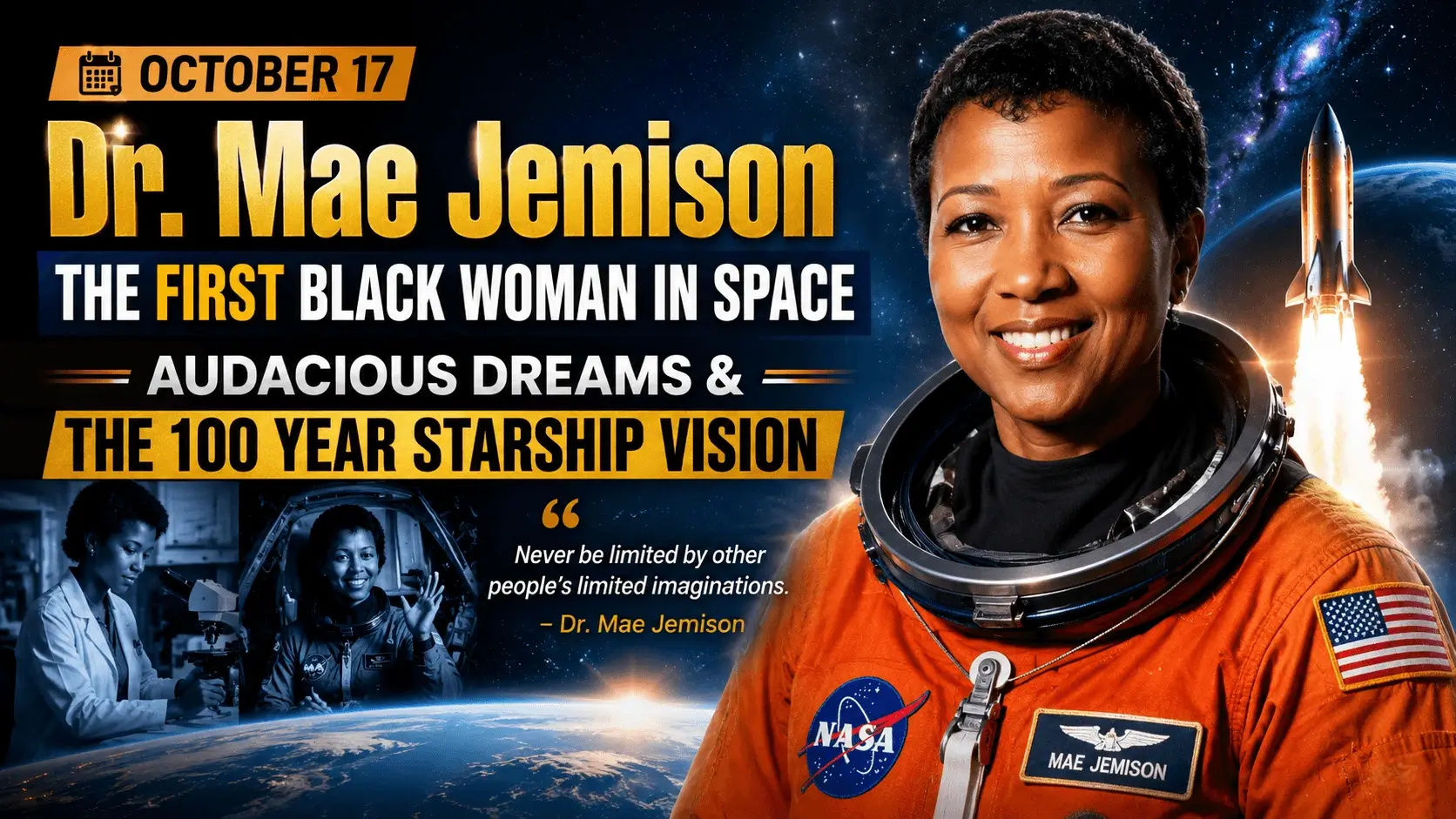
Every year on October 17, educators, scientists, and dreamers around the globe celebrate the birthday of Dr. Mae Carol Jemison (born October 17, 1956 in Decatur, Alabama). On September 12, 1992, aboard Space Shuttle Endeavour (mission STS-47), Dr. Jemison blasted into orbit, making history as the first African American woman in space. A chemical engineer, physician, Peace Corps medical officer, professional dancer, and science communicator, Dr. Jemison shattered racial and gender stereotypes, dedicating her life to STEAM education, global equity, and humanity's journey to interstellar flight.
1. South Side Chicago Dreams: Looking Up at Apollo and Lieutenant Uhura
Mae Carol Jemison was born on October 17, 1956, in Decatur, Alabama, the youngest child of Charlie Jemison, a maintenance supervisor, and Dorothy Green Jemison, an elementary school teacher. When Mae was three years old, her family moved to the South Side of Chicago to seek better educational opportunities. From early childhood, Mae demonstrated an insatiable curiosity about the natural world, spending hours at the public library reading about astronomy, chemistry, anthropology, and evolutionary biology.
During the historic Apollo moon missions of the late 1960s, young Mae watched Neil Armstrong walk on the lunar surface, but was frustrated by the complete absence of women in NASA's astronaut corps: "Everybody was excited about space, but I remember being really irritated that there were no women astronauts. People tried to explain it to me, and I said: 'Well, that's just foolish!'" Her cosmic imagination found inspiration in television, where actress Nichelle Nichols portrayed Lieutenant Uhura—a capable, brilliant Black communications officer on Star Trek. Mae resolved that one day, she too would reach the stars.
2. Stanford and Cornell: The Polymath Mind (Engineering & Medicine)
A brilliant student, Jemison entered Stanford University on a National Merit Scholarship in 1973 at the age of sixteen. Navigating the racial and gender prejudices of 1970s academia with fierce determination, she graduated in 1977 with dual Bachelor of Science degrees in chemical engineering and African and Afro-American studies. Concurrently, she directed and choreographed African-American dance and theater productions, establishing her lifelong conviction that science and the arts are interconnected expressions of human creativity.
Continuing her academic journey, Jemison earned her Doctor of Medicine (M.D.) degree from Cornell University Medical College in 1981. During medical school, she traveled to Cuba, Kenya, and Thailand, providing primary medical care in refugee camps and underserved rural clinics, confirming her commitment to global public health.
3. In the Peace Corps: Frontier Public Health in Sierra Leone and Liberia
After completing her medical internship at Los Angeles County-USC Medical Center, Dr. Jemison joined the Peace Corps in 1983 as the Area Peace Corps Medical Officer for Sierra Leone and Liberia. For two and a half years, Dr. Jemison managed pharmacy logistics, disease prevention protocols, volunteer health care, and medical evacuations across West Africa.
In Sierra Leone, when a volunteer fell critically ill with life-threatening meningitis, Dr. Jemison demonstrated extraordinary clinical decisiveness. Ignoring bureaucratic resistance, she personally chartered a military medical plane, stayed awake for fifty-six consecutive hours monitoring the patient, and safely evacuated him to Germany for life-saving treatment. Her frontier medical leadership taught her how to manage complex logistical crises under extreme pressure—skills that would soon prove vital at NASA.
4. September 12, 1992: Liftoff on Space Shuttle Endeavour (STS-47)
Following the landmark spaceflight of Sally Ride in 1983 and inspired by the active recruitment of minority astronauts, Dr. Jemison applied to NASA's astronaut training program. Out of more than 2,000 highly qualified applicants, Dr. Jemison was selected in June 1987 as one of the fifteen candidates of Astronaut Group 12—the first astronaut class chosen after the tragic 1986 Space Shuttle Challenger disaster.
On September 12, 1992, Dr. Jemison launched into Earth orbit aboard Space Shuttle Endeavour on mission STS-47 (Spacelab-J), a joint cooperative science mission between NASA and the National Space Development Agency of Japan (NASDA). As the science mission specialist, Jemison floated into history as the first Black woman in human spaceflight. Beginning each orbital shift with the cheerful salute "Hailing frequencies open" (a tribute to Lieutenant Uhura), Dr. Jemison carried into space a photograph of pioneer aviator Bessie Coleman and artifacts from the Alvin Ailey American Dance Theater.
5. The Harmony of Science and Dance: Microgravity Bone Research
Aboard Endeavour, Dr. Jemison logged 190 hours, 30 minutes, and 23 seconds in space, orbiting the Earth 127 times. She served as co-investigator on two bone cell research experiments, investigating how microgravity induces calcium loss and bone demineralization in human bone cells—research vital for long-duration space voyages and terrestrial osteoporosis treatment. She also conducted experiments on motion sickness, frog embryology, and crystal growth.
Looking out at the Earth through Endeavour's flight deck windows, Dr. Jemison experienced an epiphany of cosmic connection: "Looking down at the Earth from space, you realize that there are no political boundaries visible from orbit. We are all passengers on this beautiful, fragile blue oasis floating in the velvet dark of space. Our survival depends on recognizing our shared humanity."
6. The Jemison Group and The Earth We Share: Championing STEAM
In 1993, Dr. Jemison retired from NASA to dedicate her life to education, innovation, and technological equity. She founded The Jemison Group, a research and consulting company that integrates social and cultural issues into the design of advanced technologies, such as satellite-based telecommunications for healthcare delivery in developing countries.
She also created The Earth We Share (TEWS), an international science camp for teenagers aged 12 to 16, promoting experiential scientific literacy, critical thinking, and social problem-solving. A passionate advocate for STEAM (Science, Technology, Engineering, Arts, and Mathematics), Dr. Jemison insists that dividing science from the arts damages education: "Science provides an understanding of a universal experience; arts are a universal understanding of a personal experience. Both are required to make us whole human beings." In 1993, at the personal invitation of actor LeVar Burton, Dr. Jemison became the first real astronaut to appear on Star Trek: The Next Generation, playing Lieutenant Palmer in the episode 'Second Chances'.
7. The 100 Year Starship Initiative: Charting Humanity's Voyage to the Stars
In 2012, Dr. Jemison's organization won a competitive grant from the Defense Advanced Research Projects Agency (DARPA) and NASA to lead the visionary 100 Year Starship (100YSS) initiative. The ambitious global project aims to ensure that the scientific, technological, and societal capabilities for human interstellar flight to another star system exist within the next century.
Dr. Jemison emphasizes that interstellar travel is not merely about rocket propulsion, but about sustainable energy generation, ecological closed-loop life support, human ethics, and global inclusivity. She noted: "Pursuing an interstellar voyage compels us to solve the most urgent problems facing planet Earth today: clean energy, resource recycling, and peaceful human coexistence."
On her October 17 birthday, Dr. Mae Jemison stands as a living inspiration to dreamers of every background. She proves that when you refuse to allow other people's limited imaginations to confine your destiny, the entire universe opens its doors before you.