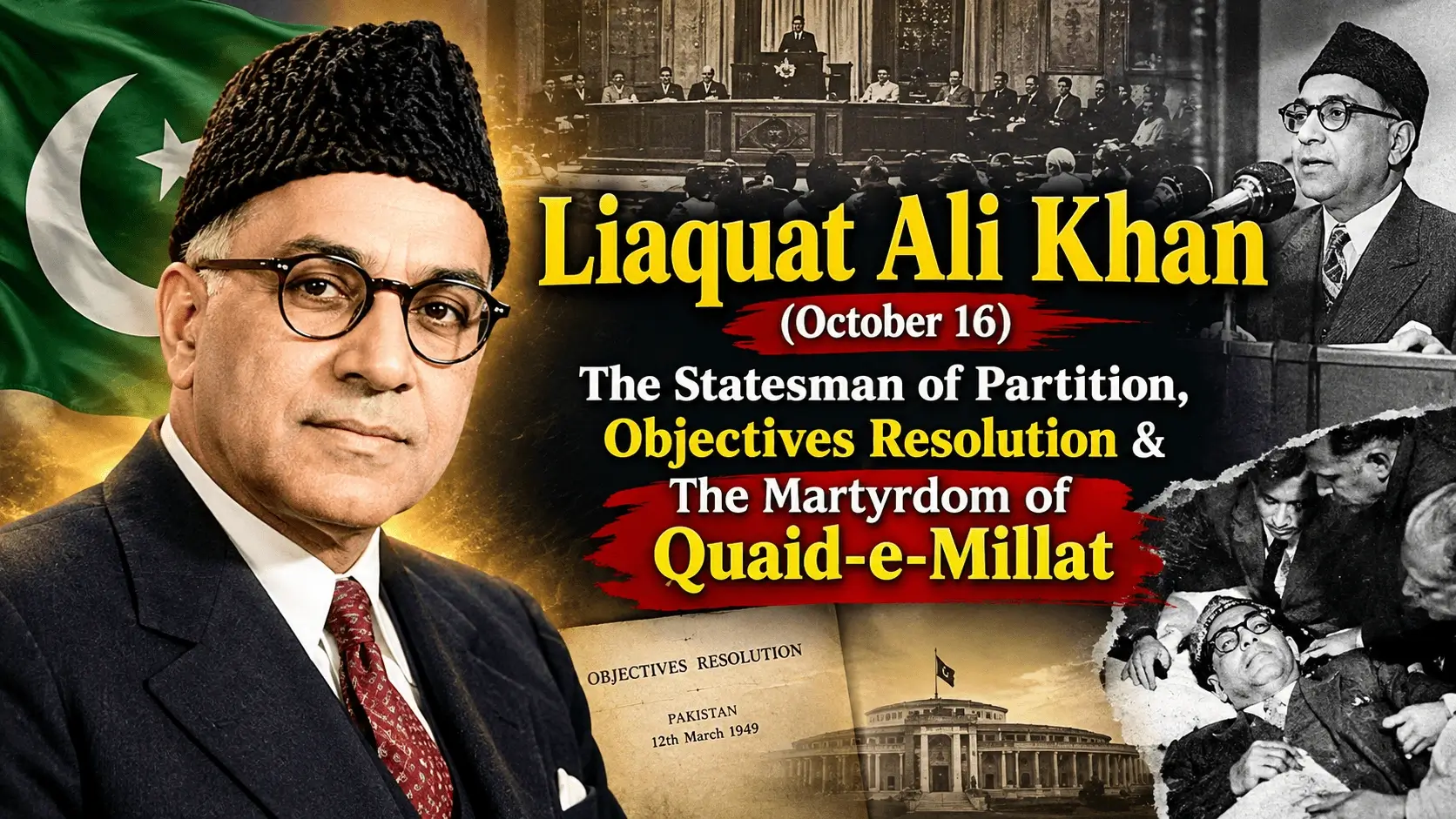
On October 16, 1951, a crisp autumn afternoon in Rawalpindi, a crowd of more than one hundred thousand citizens gathered at Company Bagh to hear the Prime Minister of Pakistan. As he stepped to the rostrum and uttered the opening invocation—"Bradaran-e-Millat" ("Brothers of the Nation")—two pistol shots rang out, mortally striking him in the chest. Falling into the arms of his colleagues, his final words were a fervent prayer: "Khuda Pakistan ki hifazat kare" ("May God preserve Pakistan"). Thus died Nawabzada Liaquat Ali Khan, the "Quaid-e-Millat" (Leader of the Nation), the principal lieutenant of Muhammad Ali Jinnah, and the foundational statesman who steered Pakistan through its perilous baptism of fire.
1. Aristocratic Heritage & The Aligarh-Oxford Crucible
Liaquat Ali Khan was born on October 1, 1895, in Karnal, East Punjab (in present-day Haryana, India), into a prominent, landed Muslim family descended from the illustrious Persian king Nausherwan the Just. Despite his inherited aristocratic wealth, Liaquat was shaped from youth by deep intellectual curiosity and an acute awareness of the socio-economic decline facing the Muslim community of British India.
He graduated in 1918 from the prestigious Muhammadan Anglo-Oriental College in Aligarh (later Aligarh Muslim University), the premier intellectual nursery of Muslim political thought. In 1919, Liaquat traveled to England to pursue higher studies at Exeter College, Oxford, earning his Master of Arts degree in law in 1921. He was called to the bar at the Inner Temple in London in 1922, gaining a sophisticated mastery of British constitutional law, parliamentary debate, and political philosophy that would later distinguish his statesmanship.
2. The Partnership with Jinnah: Rebuilding the Muslim League
Returning to India in 1923, Liaquat rejected comfortable colonial civil service appointments and entered the political arena, joining the All-India Muslim League. Elected to the United Provinces Legislative Council in 1926, he served with distinction for fourteen years, establishing a reputation for incorruptible integrity, financial acumen, and eloquent defense of minority constitutional rights.
In 1933, while visiting London with his accomplished wife, Begum Ra'ana Liaquat Ali Khan, Liaquat met with Quaid-e-Azam Muhammad Ali Jinnah, who had entered voluntary exile from Indian politics following the failure of the Round Table Conferences. Liaquat passionately persuaded Jinnah to return to India and assume the presidency of the All-India Muslim League. When Jinnah returned in 1936, he appointed Liaquat as the Honorary General Secretary of the Muslim League—a vital partnership that lasted unbroken until Jinnah's death in 1948.
While Jinnah was the visionary strategist and constitutional ambassador, Liaquat was the supreme party organizer, administrator, and diplomat. Jinnah affectionately referred to Liaquat as his "right hand", famously declaring at the League's 1943 Karachi session: "Liaquat Ali Khan is the General Secretary of the All-India Muslim League. He is a Nawabzada, but he works as a common worker. He never spared himself; he worked day and night... I have never seen a man so dedicated and unselfish."
3. The "Poor Man's Budget" of 1946: A Masterclass in Fiscal Strategy
In the autumn of 1946, following the Cabinet Mission Plan, an Interim Government of India was established. Anticipating that the Muslim League would falter in managing complex economic portfolios, the Indian National Congress offered the Muslim League the critical portfolio of Finance. To the astonishment of his political rivals, Liaquat accepted the role of Finance Member.
In March 1947, Liaquat presented what became legendary in South Asian economic history as the "Poor Man's Budget." Grounded in Islamic principles of distributive justice and progressive taxation, the budget abolished the salt tax (a burden on the impoverished peasantry), instituted a special commission to investigate wartime tax evasion, and imposed a 25 percent tax on business profits exceeding 100,000 rupees. The budget delivered profound relief to the working masses while placing severe economic checks on capitalist cartels, dramatically establishing Liaquat as a fiscal genius and champion of social equity.
4. Partition & The Birth of Pakistan: Steering Through Catastrophe
On August 14, 1947, the sovereign state of Pakistan came into existence, and Quaid-e-Azam Muhammad Ali Jinnah appointed Liaquat Ali Khan as the nation's first Prime Minister and Minister of Defence. The challenges confronting the infant state were unprecedented in modern history: millions of refugees pouring across the newly drawn borders in the largest mass migration in human history, an empty national treasury, lack of administrative infrastructure, and military conflict over Jammu and Kashmir.
Operating initially out of makeshift military barracks in Karachi with wooden crates for desks, Liaquat worked eighteen hours a day to establish the administrative machinery of statehood, coordinate massive refugee resettlement, and secure international diplomatic recognition. When Jinnah passed away on September 11, 1948—barely thirteen months after independence—the nation was plunged into inconsolable grief. Observers across the globe predicted Pakistan's immediate collapse. In this supreme national crisis, Liaquat stepped forward with calm, resolute fortitude, holding the nation together and preventing institutional disintegration.
5. The Objectives Resolution of 1949: The Constitutional Cornerstone
On March 12, 1949, Prime Minister Liaquat Ali Khan presented the Objectives Resolution to the Constituent Assembly of Pakistan—a document that remains the foundational bedrock and preamble of Pakistan's constitutional jurisprudence to this day. In a historic speech, Liaquat articulated a visionary synthesis of Islamic moral principles and modern democratic constitutionalism:
- Divine Sovereignty & Popular Trust: Declaring that absolute sovereignty over the universe belongs to God Almighty alone, and the authority exercised by the people of Pakistan through their chosen representatives is a sacred trust.
- Democratic Foundations: Mandating that the principles of democracy, freedom, equality, tolerance, and social justice as enunciated by Islam shall be fully observed.
- Minority Protection: Guaranteeing that minorities shall be freely permitted to profess, practice, and develop their religions and cultures without state coercion.
- Judicial Independence: Ensuring the complete independence of the judiciary to safeguard fundamental human rights and the rule of law.
6. Foreign Policy & The Liaquat-Nehru Pact of 1950
In foreign affairs, Liaquat charted an independent course, visiting the United States and Canada in 1950 while maintaining diplomatic ties with the Muslim world and newly decolonized nations. In April 1950, when tensions between Pakistan and India over communal riots in Bengal brought both nations to the precipice of war, Liaquat traveled courageously to New Delhi.
Demonstrating supreme statesmanship, he negotiated the historic Liaquat-Nehru Pact (Minority Pact) with Indian Prime Minister Jawaharlal Nehru. The bilateral treaty established formal institutional mechanisms to protect the life, property, and religious freedom of minority communities in both countries, diffusing an imminent war and saving countless civilian lives.
7. The Martyrdom of Quaid-e-Millat (October 16, 1951)
On the fateful afternoon of October 16, 1951, Liaquat arrived in Rawalpindi to address a massive public gathering at Company Bagh. Seconds after beginning his speech, an assassin named Said Akbar fired two hollow-point bullets from the front row into the Prime Minister's chest. The assassin was immediately shot and killed by police, leaving the conspiratorial origins of the assassination shrouded in enduring historical mystery.
Rushed to the military hospital, Liaquat was pronounced dead, having sacrificed his life in the direct service of the people. His mortal remains were flown to Karachi and laid to rest in a solemn state funeral beside the mausoleum of Quaid-e-Azam Muhammad Ali Jinnah. The park in Rawalpindi was renamed Liaquat Bagh in his honor, and the nation conferred upon him the immortal titles of Quaid-e-Millat ("Leader of the Nation") and Shaheed-e-Millat ("Martyr of the Nation").
Upon his death, it was revealed that despite having inherited vast estates in India, Liaquat had refused to claim equivalent property in Pakistan, living solely on his prime ministerial salary. His bank account held barely a few thousand rupees, and he left his widow and children with no private mansion or landed fortune. In an era of political self-aggrandizement, Liaquat Ali Khan's life stands as an unblemished monument of self-abnegation, democratic principle, and sacrificial patriotism.


