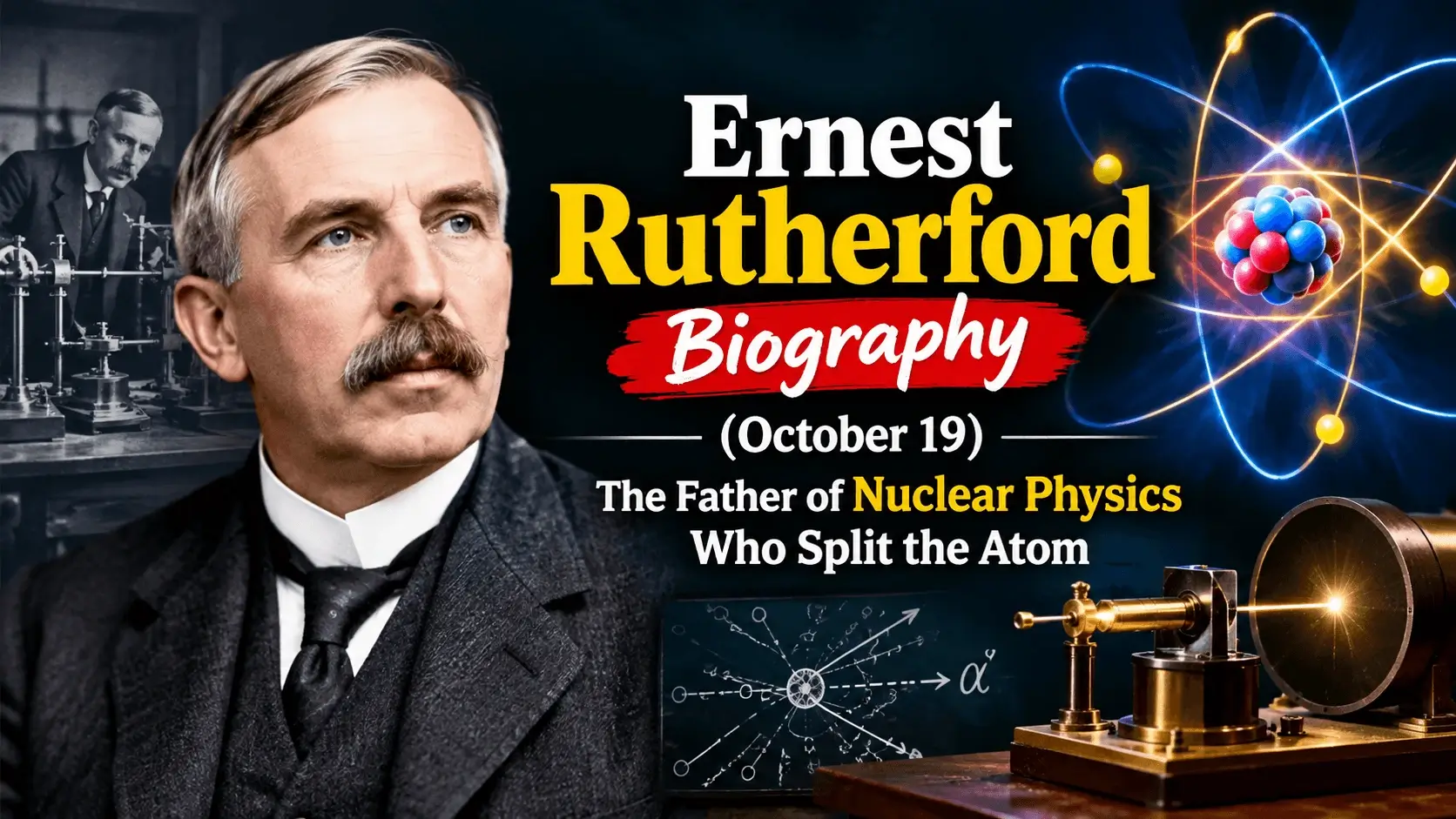
Every year on October 19, the global community commemorates Ernest Rutherford (1871–1937), "Father of Nuclear Physics", Nobel Laureate in Chemistry (1908) & Discoverer of the Atomic Nucleus & Proton. Renowned across New Zealand and globally for revolutionary contributions to Science, their life work remains an enduring testament to human courage, creative vision, and excellence.
1. Early Foundations, Background & Formative Years
Ernest Rutherford was born on August 30, 1871, in Brightwater near Nelson, New Zealand. A student of extraordinary aptitude at Canterbury College, he won a scholarship to the Cavendish Laboratory at Cambridge University to conduct research under J. J. Thomson, the discoverer of the electron.
Growing up in New Zealand, Ernest Rutherford displayed exceptional focus and dedication from an early age. Formative experiences nurtured an unwavering commitment to truth, discipline, and pushing beyond conventional boundaries.
2. Groundbreaking Breakthroughs & Monumental Achievements
At McGill University in Canada, Rutherford proved that radioactivity involves the spontaneous transmutation of one chemical element into another, a revolutionary discovery that earned him the 1908 Nobel Prize in Chemistry. Moving to the University of Manchester, he orchestrated the famous Geiger-Marsden gold foil experiment in 1909, which proved that virtually all atomic mass and positive charge is concentrated in a tiny central core—the atomic nucleus.
The impact of Ernest Rutherford's seminal work transformed our understanding of Science. Through unyielding perseverance against institutional skepticism and complex obstacles, they produced historic milestones that redefined the standards of the discipline.
3. Cultural Resonance, Philosophy & World Impact
In 1917, Rutherford achieved the first artificial nuclear reaction, splitting a nitrogen atom with alpha particles and discovering the proton. Later serving as Cavendish Professor at Cambridge, he mentored twelve future Nobel Prize laureates, including James Chadwick, Niels Bohr, and John Cockcroft. Rutherford passed away on October 19, 1937, and was laid to rest near Sir Isaac Newton in Westminster Abbey.
Widely recognized as the "Father of Nuclear Physics", Ernest Rutherford discovered alpha and beta radioactivity, proved that the atom has a concentrated central nucleus, discovered the proton, and became the first person in human history to split the atom.
4. Key Milestones & Notable Works
- Nobel Prize in Chemistry (1908 for Disintegration of Elements & Radioactivity)
- Discovery of the Atomic Nucleus (Gold Foil Experiment, 1911)
- First Artificial Nuclear Transmutation / Splitting of the Atom (1917)
- Discovery and Naming of the Proton (1920) & Hypothesis of the Neutron
- Classification of Alpha, Beta, and Gamma Radiation Rays
- Interred beside Sir Isaac Newton & Lord Kelvin in Westminster Abbey
5. Enduring Legacy for Future Generations
Generations of practitioners, scholars, and admirers worldwide continue to draw inspiration from the life of Ernest Rutherford. On October 19, we reflect upon a legacy that transcends national frontiers, reminding humanity that visionary purpose and integrity endure across the centuries.
6. Frequently Asked Questions (FAQ) About Ernest Rutherford
When and where was Ernest Rutherford born?
Ernest Rutherford was born on 1871-08-30 in Brightwater, New Zealand.
What is Ernest Rutherford most famous for?
Ernest Rutherford is globally celebrated for: "Father of Nuclear Physics", Nobel Laureate in Chemistry (1908) & Discoverer of the Atomic Nucleus & Proton.
What are the primary honors and achievements of Ernest Rutherford?
Key achievements include Nobel Prize in Chemistry (1908 for Disintegration of Elements & Radioactivity) and Discovery of the Atomic Nucleus (Gold Foil Experiment, 1911).
Why is October 19 significant for Ernest Rutherford?
October 19 marks the historic solemn memorial anniversary of Ernest Rutherford, observed worldwide by historians, admirers, and students of Science.


