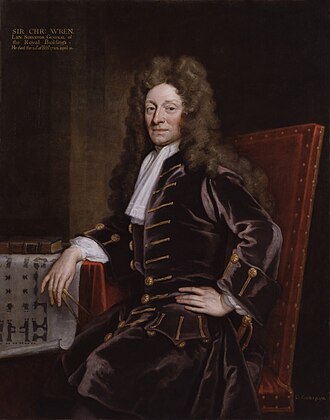
Every year on October 20, the international community commemorates Sir Christopher Wren (Master Architect of the English Baroque, Surveyor of the King's Works & Mastermind of St Paul's Cathedral). Celebrated across United Kingdom and worldwide for defining contributions to architecture, their life remains an inspiring beacon of human courage, vision, and excellence.
1. Early Foundations, Background & Formative Years
Sir Christopher Wren was born on October 20, 1632, in East Knoyle, Wiltshire. Educated at Wadham College, Oxford, Wren was first celebrated as an extraordinary astronomer, mathematician, and anatomist, earning election as Savilian Professor of Astronomy at Oxford and co-founding the Royal Society of London, which he served as president from 1680 to 1682. Isaac Newton praised him as one of the three greatest geometricians of his era. When the Great Fire of London incinerated four-fifths of the capital in September 1666, King Charles II appointed Wren to oversee the reconstruction of London's sacred architecture. Wren seized the opportunity to realize an English Baroque revival. Over the following four decades, he designed and constructed fifty-two parish churches—each with a radically inventive, soaring steeple that redefined London's skyline—including St Stephen Walbrook, St Mary-le-Bow, and St Bride's. Wren's supreme architectural monument is St Paul's Cathedral, constructed between 1675 and 1710. Featuring a triple-domed structure engineered with astonishing mathematical daring, it became the civic heart and spiritual symbol of Britain. Wren also designed the Royal Hospital Chelsea, the Royal Naval College at Greenwich, and the elegant south and east wings of Hampton Court Palace. When he died in 1723 at age ninety, he was interred inside the crypt of St Paul's beneath the immortal Latin epitaph: 'Lector, si monumentum requiris, circumspice' ('Reader, if you seek his monument, look around you').
Growing up in United Kingdom, Sir Christopher Wren was guided by an innate curiosity, unwavering discipline, and an refusal to accept mediocrity. These formative experiences forged the intellectual and moral bedrock that would later define their world-changing accomplishments.
2. Groundbreaking Breakthroughs & Monumental Achievements
One of the most acclaimed architects and polymaths in English history, Sir Christopher Wren rebuilt fifty-two parish churches in the City of London following the catastrophic Great Fire of 1666, crowned by his immortal masterpiece, St Paul's Cathedral on Ludgate Hill.
Throughout their career, Sir Christopher Wren surmounted institutional obstacles, skepticism, and severe adversity. Through unyielding resolve, they established new benchmarks in architecture that continue to shape the modern world.
3. Cultural Resonance, Philosophy & World Impact
The philosophical principles embodied by Sir Christopher Wren extend far beyond regional frontiers. Admirers and scholars across Europe, the Americas, Africa, Asia, and Oceania recognize their timeless contribution to human progress, ethical leadership, and creative mastery.
4. Key Milestones & Notable Works
- St Paul's Cathedral, London (Historic Baroque Masterpiece, Completed 1710)
- Reconstruction of 52 City of London Parish Churches after the Great Fire of 1666
- Royal Hospital Chelsea & Royal Naval College, Greenwich
- South and East Wing Expansion of Hampton Court Palace
- Co-Founder and President of the Royal Society (1680–1682)
- Sheldonian Theatre, Oxford & Wren Library at Trinity College, Cambridge
5. Enduring Legacy for Future Generations
On October 20, we reflect upon a legacy that transcends time. For aspiring students, creators, and leaders everywhere, the journey of Sir Christopher Wren serves as proof that conviction, mastery, and dedication leave an indelible mark upon human history.
6. Frequently Asked Questions (FAQ) About Sir Christopher Wren
When and where was Sir Christopher Wren born?
Sir Christopher Wren was born on 1632-10-20 00:00:00 in East Knoyle, Wiltshire, England.
What is Sir Christopher Wren globally renowned for?
Sir Christopher Wren is world-famous as: Master Architect of the English Baroque, Surveyor of the King's Works & Mastermind of St Paul's Cathedral.
What are the foremost achievements of Sir Christopher Wren?
Prominent achievements include: St Paul's Cathedral, London (Historic Baroque Masterpiece, Completed 1710) and Reconstruction of 52 City of London Parish Churches after the Great Fire of 1666.
Why is October 20 significant for Sir Christopher Wren?
October 20 marks the historic Memorial & Legacy of Sir Christopher Wren, celebrated across United Kingdom and around the world.


