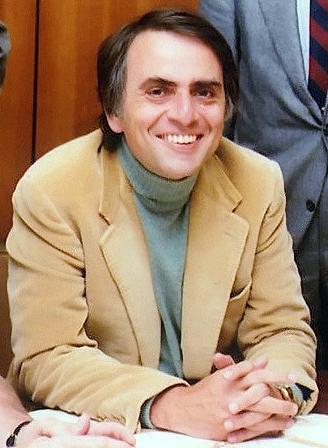
Every year on November 9, the world commemorates the extraordinary life and legacy of Carl Sagan (American Astronomer, Planetary Scientist, Cosmologist & Science Communicator ('Cosmos')). Celebrated across United States and worldwide for defining contributions to science, their life remains an inspiring beacon of human courage, vision, and excellence.
1. Early Foundations, Background & Formative Years
Carl Edward Sagan was born on November 9, 1934, in Brooklyn, New York. Educated at the University of Chicago, where he earned his doctorate in astronomy and astrophysics in 1960, he demonstrated that Venus's atmosphere produces an extreme greenhouse effect heating the surface above 450°C and proved that seasonal darkening on Mars was caused by global dust storms rather than vegetation.
As Professor of Astronomy and Director of the Laboratory for Planetary Studies at Cornell University, Sagan played a pivotal role in NASA's Mariner, Viking, Voyager, and Galileo missions. He designed the Pioneer plaque and spearheaded the curation of the Voyager Golden Records—carrying Earth's greetings, music, and images into interstellar space.
Beyond research, Sagan was humanity's foremost cosmic evangelist. In 1980, he co-wrote and narrated Cosmos: A Personal Voyage, which became the most-watched series in American public television history. He advocated nuclear disarmament (co-discovering the nuclear winter scenario) and scientific skepticism in The Demon-Haunted World. Sagan passed away from pneumonia following myelodysplasia in 1996, leaving behind an indelible cosmic legacy symbolized by his poetic reflection on Earth as a 'Pale Blue Dot'.
Growing up in United States, Carl Sagan was guided by an innate curiosity, unwavering discipline, and a refusal to accept mediocrity. These formative experiences forged the intellectual and moral bedrock that would later define their world-changing accomplishments.
2. Defining Achievements & Global Career Breakthroughs
Across decades of dedicated service and relentless practice, Carl Sagan redefined standards of excellence in science. Whether breaking barriers, innovating masterworks, or transforming public perception, their career represents the pinnacle of professional dedication.
3. Philosophy, Quotations & Guiding Worldview
Throughout their life, Carl Sagan articulated profound insights into human potential, creative resilience, and moral responsibility. Their words continue to offer timeless guidance for succeeding generations.
4. Key Milestones & Notable Works
- Co-created and hosted the landmark PBS television series 'Cosmos: A Personal Voyage' (1980)
- Curated the interstellar message aboard NASA's Voyager 1 & 2 Golden Records (1977)
- Discovered the extreme runaway greenhouse effect on Venus and seasonal dust cycles on Mars
- Penned the Pulitzer Prize-winning book 'The Dragons of Eden' (1977) and sci-fi bestseller 'Contact' (1985)
- Authored 'Pale Blue Dot: A Vision of the Human Future in Space' (1994) and championed scientific skepticism
5. The Enduring Legacy of Carl Sagan
Generations of practitioners, scholars, and future leaders trace their inspiration directly to the path blazed by Carl Sagan. Their courage reminds us that true greatness requires relentless perseverance, creative boldness, and a lifelong commitment to uplifting humanity.